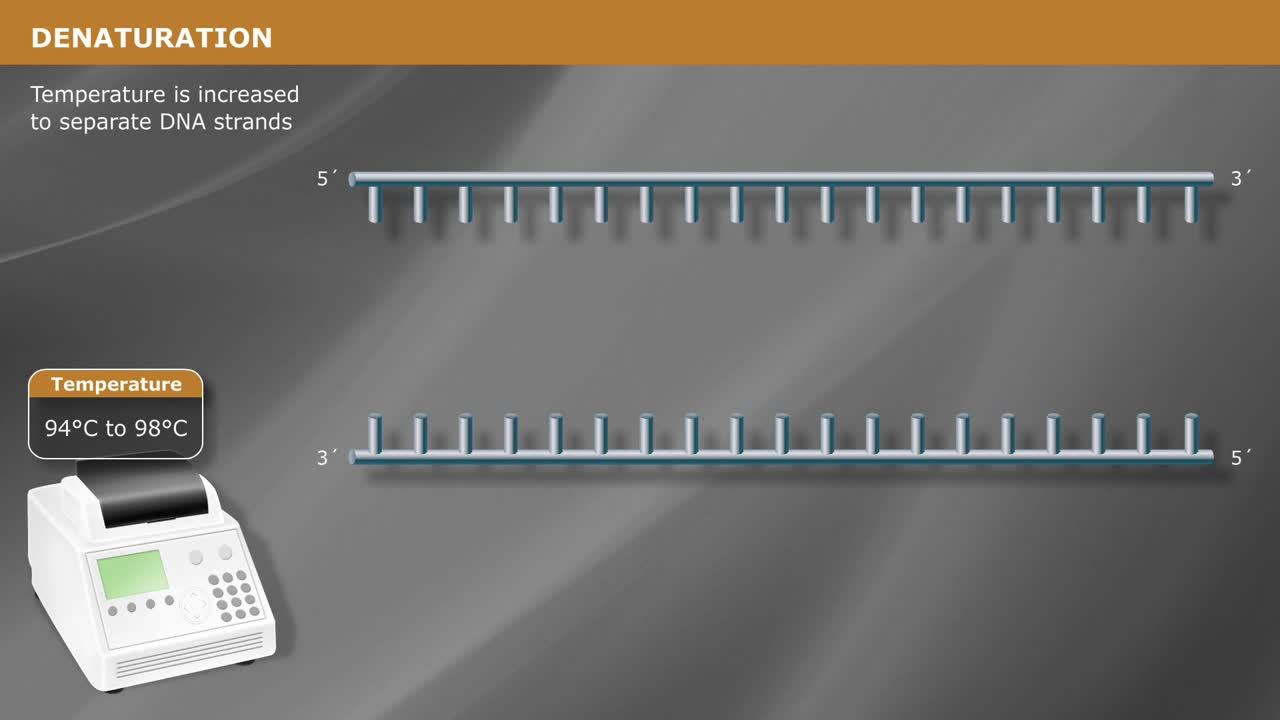
DNA Preparation
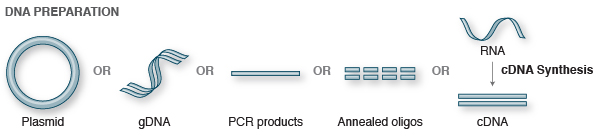
Traditional cloning by restriction endonuclease digestion can use any of a number of different source DNA types. Genomic DNA can be digested with a restriction enzyme and cloned into a compatible vector site to produce a library of different inserts, all from the same source DNA. DNA already cloned into one vector can be transferred (subcloned) to a new recipient vector by cutting out the DNA with restriction enzymes and cloning into the corresponding sites of the second vector. This is frequently undertaken to facilitate protein expression or transcription of RNA, for example, which might not be possible from the original vector.
PCR is often used for generating DNA for cloning and frequently restriction sites are incorporated into the primer sites so that the amplified DNA can be digested and cloned into compatible restriction sites of the cloning vector. Any type of DNA containing the desired sequence can serve as the template for PCR. Cloning with two distinct restriction enzymes ensures that non-compatible ends are generated on each molecule, thereby preventing simple vector recircularization and forcing inserts to be cloned directionally. This can be important for ensuring a translational open reading frame for protein expression. Modification of DNA ends following restriction digestion can be helpful in certain situations. For example, in non-directional cloning, where a single restriction enzyme is used, dephosphorylation of the digested vector DNA will prevent recircularization of the vector, thereby increasing the proportion of the desired recombinant DNA molecules.
PCR is increasingly used for preparing DNA for cloning applications. Amplified DNA can either be cloned directly, or following restriction digestion with restriction sites engineered into the primers used for PCR. Alternatively, amplified DNA can be used in Seamless Cloning strategies such as NEBuilder HiFi DNA Assembly or in Ligation Independent Cloning. The vector molecules for these cloning methods may also be produced by PCR. DNA amplified with Taq polymerase has a template-independent single adenosine (A) added at the 3’ ends which allows cloning into complementary T-tailed vectors. High-fidelity proofreading polymerases do not add additional bases allowing cloning of the amplified DNA into blunt-ended restriction sites. Depending on the chosen cloning strategy, the ends of amplified DNA can be modified by A-tailing, blunting, or addition or removal of 5’-phosphate groups. Complementary DNA (cDNA) generated by reverse transcription of RNA can also be amplified by PCR. This ability to synthesize DNA from RNA templates enables cloning of sequences corresponding to gene transcripts.
Learn more about the different methods to prepare DNA: Restriction Enzyme Digestion, PCR and Reverse Transcription (cDNA Synthesis)
Choose Type:
- Affinity Purification and On-column Cleavage (E6901)
- Comet Assay - Modified for Detection of Oxidized Bases Using the Repair Endonucleases Fpg, hOGG1 and Endonuclease III (Nth)
- Construction of the Fusion Plasmid (E6901)
- Fusion Protein Expression (E6901)
- Preparation of Media and Solutions (E6901)
- Primer Design for Restriction Enzyme Cloning (E6901)
- Simplified Expression and Purification Protocol (E6901)
- Optimizing Restriction Endonuclease Reactions
- Fusion Constructs (E6901)
- Protocol for Cre Recombinase (M0298)
- Protocol for Direct Digestion of gDNA during droplet digital PCR (ddPCR)
- Protocol for generating 32 bp fragments from modified CpG sites in genomic DNA using MspJI, FspEI or LpnPI
-
Why Choose the K. lactis Protein Expression Kit?
Review the advantages of the K. lactis Protein Expression Kit for rapid, high yield protein expression in yeast.
-
A Modern Day Gene Genie Sir Richard Roberts on Rebase
- Molecular Cloning Technical Guide
- Recleavable Filled-in 5' Overhangs
- Compatible Cohesive Ends and Generation of New Restriction Sites
- Dam-Dcm and CpG Methylation
- Recleavable Blunt Ends
- Why Choose Recombinant Enzymes?
- Cleavage Of Supercoiled DNA
- Frequencies of Restriction Sites
- Troubleshooting Guide for Cloning
- Activity at 37°C for Restriction Enzymes with Alternate Incubation Temperatures
- Restriction Endonucleases - Survival in a Reaction
- NEBuffer Activity/Performance Chart with Restriction Enzymes
- Star Activity
- Digestion of Agarose-Embedded DNA: Info for Specific Enzymes
- Alteration of Apparent Recognition Specificities Using Methylases
- Restriction Enzyme Diluent Buffer Compatibility
- cDNA/Reverse Transcriptase Tips
- Cleavage Close to the End of DNA Fragments
- Traditional Cloning Quick Guide
- Double Digests
- Optimizing Restriction Endonuclease Reactions
- Heat Inactivation
- Site Preferences
Feature Articles
Brochures
Selection Tools
Troubleshooting Guides
Usage Guidelines
- Shah, S., Sanchez, J., Stewart, A., et al. (2015) Probing the Run-On Oligomer of Activated SgrAI Bound to DNA PLoS One; 10(4), PubMedID: 25880668, DOI: 10.1371/journal.pone.0124783.
Products and content are covered by one or more patents, trademarks and/or copyrights owned or controlled by New England Biolabs, Inc (NEB). The use of trademark symbols does not necessarily indicate that the name is trademarked in the country where it is being read; it indicates where the content was originally developed. All other trademarks are the property of their respective owners. The use of this product may require the buyer to obtain additional third-party intellectual property rights for certain applications. For more information, please email busdev@neb.com.
This product is intended for research purposes only. This product is not intended to be used for therapeutic or diagnostic purposes in humans or animals.