
Measuring Targeting Efficiency with the EnGen® Mutation Detection Kit
Return to Genome Editing with CRISPR/CasThe T7 Endonuclease I mutation detection assay is a widely used method to identify on-target genome editing (1,2). This assay detects heteroduplex DNA that results from annealing a DNA strand, including desired mutations, with a wild-type DNA strand. The EnGen® Mutation Detection Kit (NEB #E3321) provides optimized reagents for performing robust T7 Endonuclease-based detection of genome editing events. The kit is designed with no cleanup requirement between PCR and digestion.
Unfortunately, many polymerase buffers have components that can inhibit a T7 endonuclease reaction. The kit includes Q5® Hot Start High Fidelity 2X Master Mix for robust amplification and high fidelity. When performing a T7 Endonuclease I assay using any polymerases except Q5 High-Fidelity DNA polymerase with Q5 reaction buffer, OneTaq with Standard buffer, or Taq DNA polymerase with ThermoPol buffer, use the Monarch® Spin PCR cleanup kit (NEB #T1130) prior to digestion.
- Reyon, D. et al. (2012) Nat. Biotechnol., 30(5):460-5
- Vouillot, L., et al. (2015) G3 (Bethesda), 5(3):407-15
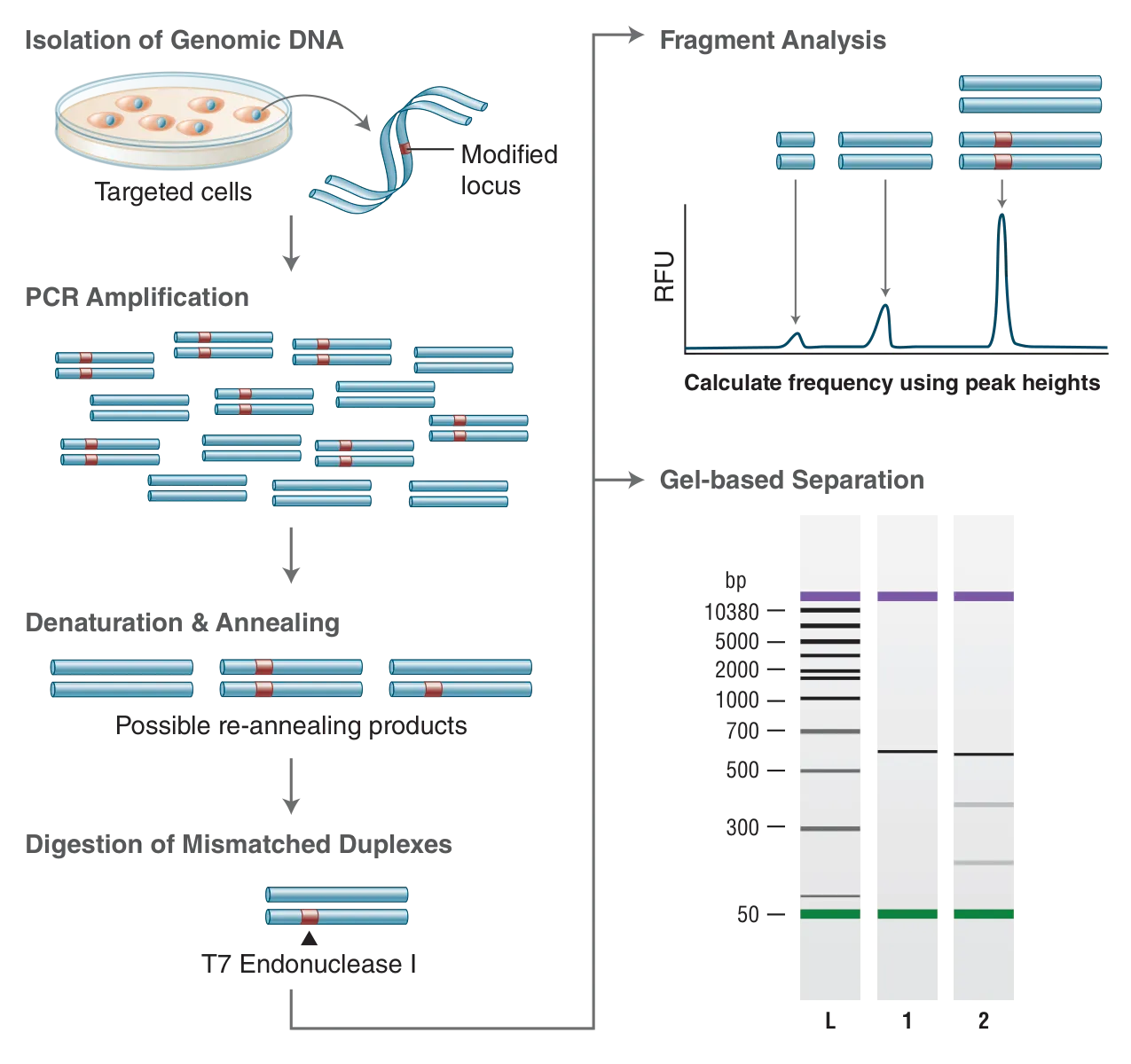
Genomic DNA is amplified with primers bracketing the modified locus. PCR products are then denatured and re-annealed yielding 3 possible structures. Duplexes containing a mismatch are digested by T7 Endonuclease I. The DNA is then electrophoretically separated and fragment analysis is used to calculate targeting efficiency.
Learn about Genome Editing with CRISPR/Cas

 |
Choose a product for your application |
|
Explore featured products |
|