Cell-Free Protein Expression
Cell-free protein synthesis (CFPS) is a protein expression approach that enables production of a target protein without the use of living cells. In CFPS, a solution containing all the cellular machinery needed to direct protein synthesis (e.g., ribosomes, tRNAs, enzymes, cofactors, amino acids, etc.) is used to transcribe and translate a supplied nucleic acid template (e.g., plasmid DNA, linear DNA or mRNA). In a simple biochemical reaction, CFPS generates desired proteins in just hours compared to traditional in vivo protein expression approaches that take several days or longer.
CFPS is well-suited for many applications. The speed and ease of CFPS facilitates high throughput protein expression in applications such as protein engineering, mutagenesis studies, and enzyme screening. In addition, CFPS is often used to generate proteins for biophysical and structure-function analyses. Other CFPS applications include the production of proteins that are toxic to host cells in vivo, expression of proteins with modified or unnatural amino acids, and incorporation of post-translational modifications (in some CFPS systems). Due to their robust performance, scalability and cost-effectiveness, CFPS systems have also been adopted in metabolic engineering and synthetic biology applications.
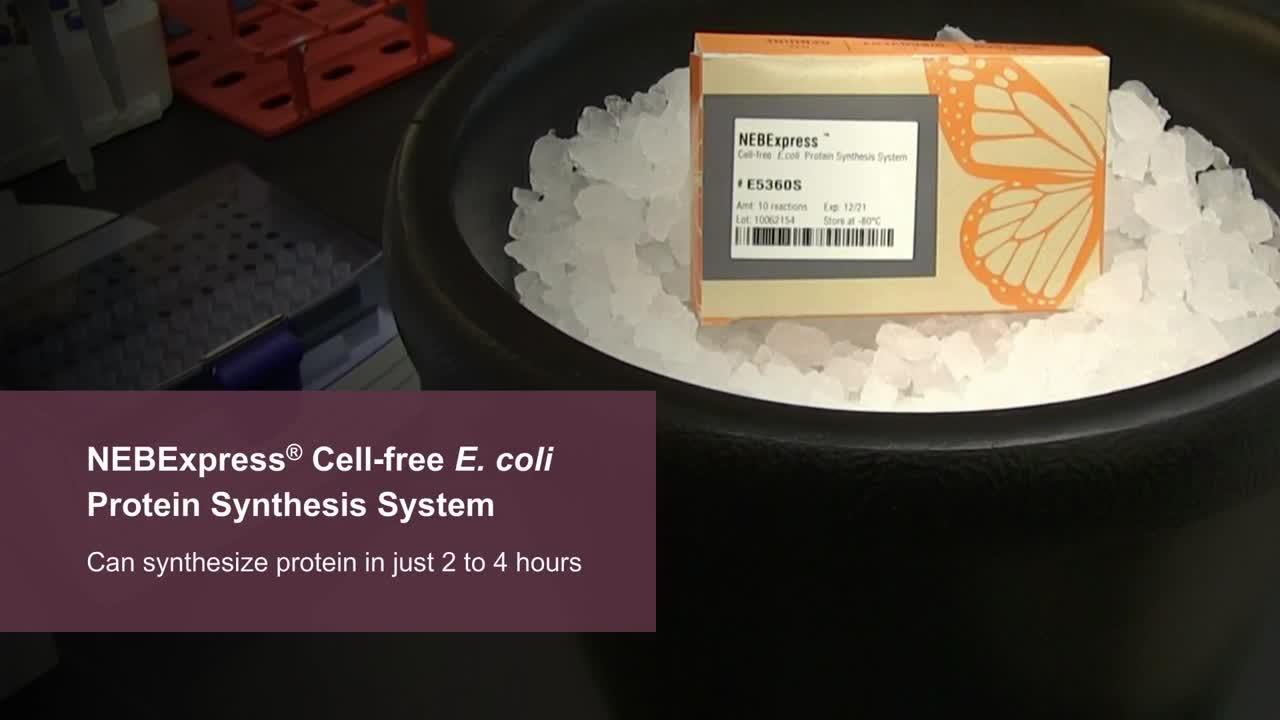
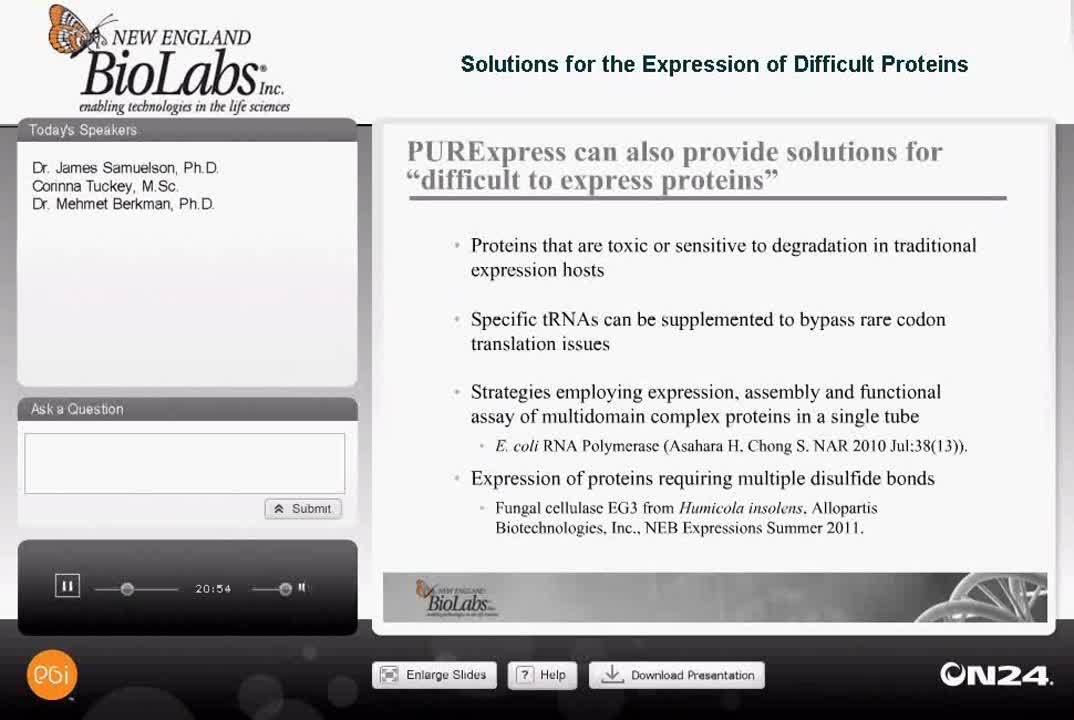
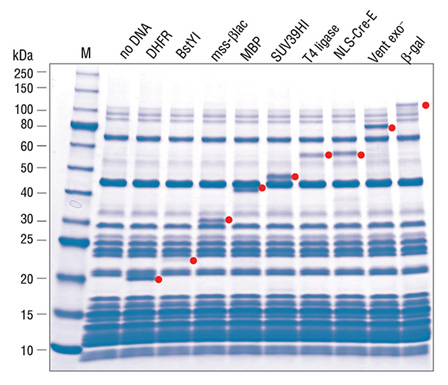
There are several different types of CFPS systems. Many systems are comprised of a solution containing protein synthesis machinery derived from a cell lysate. Such systems have been made from various types of cells including E. coli, yeast, plant and animal cells. The NEBExpress® Cell-free E. coli Protein Synthesis System (NEB #E5360) is a lysate-based system derived from E. coli cells that have been engineered for high in vitro expression performance. This system offers high expression levels, the ability to produce high molecular weight proteins, scalability, and is cost-effective for high throughput expression applications. Alternatively, CFPS can be achieved using purified protein synthesis machinery. The PURExpress® In Vitro Protein Synthesis Kit (NEB #E6800) is a reconstituted mixture of numerous individually purified components that are required for E. coli transcription and translation. This system permits the production of proteins in the absence of detrimental E. coli activities (e.g., nucleases and proteases).
Choose Type:
- Based on my application, should I use the NEBExpress® Cell-free E. coli Protein Synthesis System (NEB #E5360) or the PURExpress® In Vitro Protein Synthesis Kit (NEB #E6800)?
- What is the difference between NEBExpress® Cell-free E. coli Protein Synthesis System and the PURExpress In Vitro Protein Synthesis Kit?
- Protein Synthesis Reaction using PURExpress (E6800)
- Quick Start Protocol for NEBExpress® Cell-free E. coli Protein Synthesis System
- Determination of Protein Synthesis Yield with PURExpress (E3313, E6800, E6840, E6850)
- Protein Synthesis Reaction using PURExpress® ∆ (aa, tRNA) Kit (E6840)
- Purification of Synthesized Protein using Reverse His-tag Purification
- Protein Synthesis Reaction using PURExpress® ∆ RF123 Kit (E6850)
- Protein Synthesis Reaction using PURExpress (E3313)
- Analysis of Synthesized Protein using PURExpress (E6800)
- Analysis of Synthesized Protein using PURExpress (E6840)
- Analysis of Synthesized Protein using PURExpress (E3313)
- Measurement of 35S-Methionine Incorporation by TCA Precipitation and Yield Determination using PURExpress
- Poly(A) Tailing of RNA using E. coli Poly(A) Polymerase (NEB #M0276)
- Analysis of Synthesized Protein using PURExpress (E6850)
- PURExpress Disulfide Bond Enhancer (E6820)
- Use of the PURExpress® in vitro Protein Synthesis Kit, Disulfide Bond Enhancer and SHuffle® Competent E. coli for heterologous in vitro and in vivo cellulase expression.
- Using the PURExpress® In Vitro Protein Synthesis Kit for Heterologous In Vitro Expression and Functional Screening of FMN-dependent Oxidoreductase Variants
- NEBExpress® Cell-free E. coli Protein Synthesis System
- Cell-free Expression and Rapid Analysis of Single-Chain Antibody Fragments
-
Avoid Common Obstacles in Protein Expression
Read how to avoid common obstacles in protein expression that prevent interactions with cellular machinery.
-
The Future of Cell-Free Protein Synthesis
Cell-free protein synthesis has the potential to become one of the most important high throughput technologies for functional genomics and proteomics.
-
Over 40 years in protein expression and purification – a historical perspective
This article provides an overview of the advances in protein expression and purification methodology over the past 40 years.
- Purification Beads, Columns and Resins Brochure
- Protein Expression & Purification Brochure
- Protein Expression and Purification Selection Chart
- PURExpress® vs. NEBExpress® Application Chart
Feature Articles
Brochures
Selection Tools
- His-Tagged Translation Factors
- Initiation Factors (IF1, IF2, IF3)
- Elongation Factors (EF-Tu, EF-Ts, EF-G)
- Release Factors (RF1, RF2, RF3)
- Ribosome Recycling Factor
- 20 Aminoacyl tRNA synthetases
- Methionyl tRNA formyltransferase
- E. coli Ribosomes
- E. coli tRNAs
- Energy Regeneration System
- NTPs, Amino Acids, Salts, Buffer
In addition, recombinant T7 RNA polymerase is used to couple transcription to translation. The PURE system represents an important step towards a totally defined in vitro transcription/translation system, thus avoiding the “black box” nature of the cell extract-based systems.
Products and content are covered by one or more patents, trademarks and/or copyrights owned or controlled by New England Biolabs, Inc (NEB). The use of trademark symbols does not necessarily indicate that the name is trademarked in the country where it is being read; it indicates where the content was originally developed. All other trademarks are the property of their respective owners. The use of this product may require the buyer to obtain additional third-party intellectual property rights for certain applications. For more information, please email busdev@neb.com.
This product is intended for research purposes only. This product is not intended to be used for therapeutic or diagnostic purposes in humans or animals.