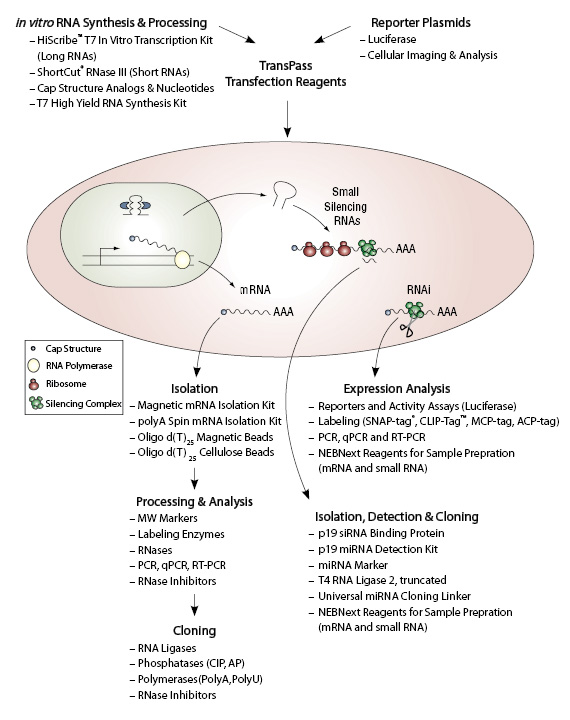
RNA Cloning
Molecular cloning is a set of experimental steps in which recombinant DNA is assembled from a species to be cloned, and a species that will serve as the host for replication. The ability to use RNA-directed DNA synthesis allows researchers to obtain a clone library representative of the RNA population (or specific members thereof) in the cells of interest.
In general, molecular cloning experiments use a laboratory strain of the bacterium E. coli and a plasmid cloning vector as the host DNA. Cloning vectors typically have at least one restriction endonuclease recognition site that, upon treatment with the appropriate enzyme, will be prepared to accept foreign DNA treated with the same endonuclease(s). The vector and foreign DNA are then ligated together, typically using a phage-encoded DNA ligase, and then transformed into host cells. The cloning vector usually contains a selectable genetic marker, generally a gene that confers antibiotic resistance, so that when the cells are grown in medium containing the antibiotic, only cells that have been successfully transformed with vector DNA will grow. Cloning vectors typically have an additional gene that allows the experimenter to differentiate between vectors that have integrated the foreign DNA and those that have not. The clones that have foreign DNA inserts can then be selected for use in downstream studies
- Cooper, Geoffery M. The Cell: A Molecular Approach. 4th ed. Washington D.C.: ASM Press, 2007. 118-128.
- McKee, Trudy. Biochemistry: The Molecular Basis of Life. 4th ed. New York: Oxford University Press, 2009. 701-2.
Choose Type:
- A Typical Deadenylation Reaction (M0331)
- A Typical DNase I Reaction Protocol (NEB #M0303)
- Protocol for ligation of the 3´ OH of RNA to the 5´ pre-adenylated DNA with T4 RNA Ligase 2 truncated K227Q (NEB #M0351)
- RNA Circularization using T4 RNA Ligase 1 (ssRNA Ligase) (NEB #M0204)
- Protocol for Dephosphorylation of 5´-ends of DNA using Antarctic Phosphatase (NEB #M0289)
- Protocol for Dephosphorylation of 5´-ends of DNA using rSAP (NEB #M0371)
- In vitro digestion of DNA with Cas9 Nuclease, S. pyogenes (NEB #M0386)
- Ligation of an ssRNA-OH 3' to a 5' PO4-ssRNA/ssDNA adaptor using High Concentration T4 RNA Ligase 1 (NEB #M0437)
- 3´ End Labeling of RNA using T4 RNA Ligase 1
- Protocol for Dephosphorylation of 5´-ends of DNA using Quick Dephosphorylation Kit (M0508)
- Typical Protocol for RNA Ligation (NEB #M0458)
- Reverse Transcriptase Selection Chart
- RNA Polymerase Selection Chart
- RNA Ligase Selection Chart
Selection Tools
Products and content are covered by one or more patents, trademarks and/or copyrights owned or controlled by New England Biolabs, Inc (NEB). The use of trademark symbols does not necessarily indicate that the name is trademarked in the country where it is being read; it indicates where the content was originally developed. All other trademarks are the property of their respective owners. The use of this product may require the buyer to obtain additional third-party intellectual property rights for certain applications. For more information, please email busdev@neb.com.
This product is intended for research purposes only. This product is not intended to be used for therapeutic or diagnostic purposes in humans or animals.