CLIP Surface
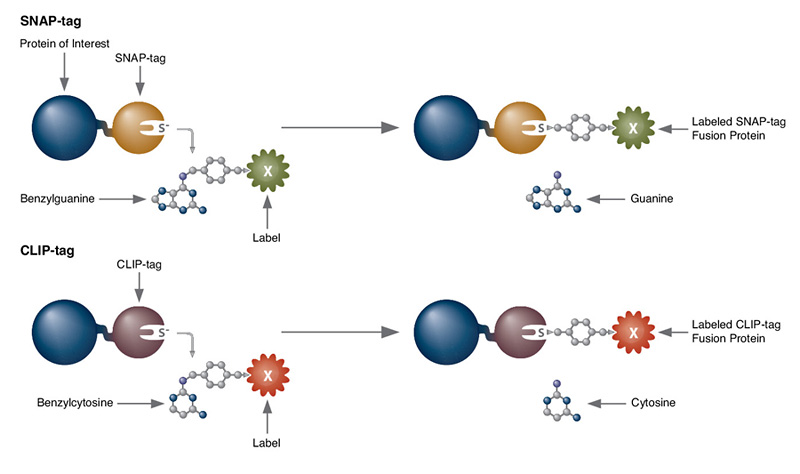
Membrane proteins are challenging to study given their hydrophobic nature, generally low native abundance and intrinsic instability(1,2). Regardless, half of all protein drug targets are membrane proteins. For imaging, most fluorescent proteins (i.e. GFP) cannot specifically visualize cell surface subpopulations. However, CLIP-tag, SNAP-tag and cell surface-specific ACP/MCP-tag systems can specifically label subpopulations of target protein expressed on the cell surface using non-cell permeable substrates (3). This approach permits discrimination of different populations of a cell surface protein: those properly translocated to the plasma membrane from those retained in the secretory pathway or already internalized (e.g. upon ligand binding).
References
- Lacapère J-J, Pebay-Peyroula E, Neumann J-M, Etchebest C. (2007) Trends Biochem Sci. 32, 259–270. PMID: 17481903
- von Heijne G. (2007) J Intern Med. 261, 543–557. PMID: 17547710
- Keppler, A., Pick, H., Arrivoli, C. et al. (2004) Proc. Natl. Acad. Sci. USA, 101, 9955. PMID: 15226507
CLIP-tag™ is a trademark of New England Biolabs, Inc.
SNAP-tag® is a registered trademark of New England Biolabs, Inc.
Choose Type:
- Cellular Labeling (E9230)
- Cellular Labeling (S9217)
- Cellular Labeling (S9219)
- Cellular Labeling (S9232)
- Cellular Labeling (S9233)
- Cellular Labeling (S9234)
- Cloning of CLIP-tag Fusions in pCLIPf (N9215)
- Expression of CLIP-tag Fusions (N9215)
- Labeling of Proteins in vitro (S9217)
- Labeling of Proteins in vitro (S9219)
- Labeling of Proteins in vitro (S9220)
- Labeling of Proteins in vitro (S9232)
- Labeling of Proteins in vitro (S9233)
- Labeling of Proteins in vitro (S9234)
- Labeling of Proteins in Solution (E9230)
- Use of CLIP-Cell Block with CLIP-Cell Substrates (E9230)
- Use with CLIP-tag substrates (S9220)
- View the video "Fluorescent Labeling of COS-7 Expressing SNAP-tag Fusion Proteins for Live Cell Imaging" in the Journal of Visualized Experiments (JoVE)
-
SNAP-tag® Technologies: Tools to Study Protein Function
Read about the NEB’s set of protein tools for the specific labeling (SNAP-, CLIP-, ACP- and MCP-tags) of fusion proteins.
- Cellular Imaging & Analysis Brochure
- SNAP-tag® and CLIP-tag™ Substrate Selection Chart
- SNAP-tag® and CLIP-tag™ Substrate Selection Chart
- Comparison of SNAP-tag®/CLIP-tag™ Technologies to GFP
- Labeling with SNAP-tag® Technology Troubleshooting Guide
Feature Articles
Brochures
Selection Tools
Troubleshooting Guides
- Maffei, M., Morelli, C., Graham, E., Patriarca, S., Donzelli, L., Doleschall, B., de Castro, Reis, F., Nocchi, L., Chadick, C.H., Reymond, L., Correa, I.R., Jr., Johnsson, K., Hackett, J.A., Heppenstall, P.A (2019) A ligand based system for receptor specific delivery of proteins Sci Rep; 9(1), 19214.. PubMedID: 31844114, DOI: 10.1038/s41598-019-55797-1
- Clone and express once, then use with a variety of substrates
- Non-toxic to living cells
- Wide selection of fluorescent substrates
- Highly specific covalent labeling
- Simultaneous dual labeling
- Simultaneous dual protein labeling on the surface of live cells
- Protein localization and translocation
- Pulse-chase experiments
- Receptor internalization studies
- Selective cell surface labeling
- Protein detection in SDS-PAGE
- Flow cytometry
- High throughput binding assays in microtiter plates
- Biosensor interaction experiments
- FRET-based binding assays
- Single molecule labeling
- Super-resolution microscopy
Products and content are covered by one or more patents, trademarks and/or copyrights owned or controlled by New England Biolabs, Inc (NEB). The use of trademark symbols does not necessarily indicate that the name is trademarked in the country where it is being read; it indicates where the content was originally developed. All other trademarks are the property of their respective owners. The use of this product may require the buyer to obtain additional third-party intellectual property rights for certain applications. For more information, please email busdev@neb.com.
This product is intended for research purposes only. This product is not intended to be used for therapeutic or diagnostic purposes in humans or animals.