Highly Efficient Peptide Binder Discovery Using mRNA Display
Posted on Monday, August 24, 2026
By
Topic: What is Trending in Science, Tips for the lab
The scientists at PeptiFinder Biotech knew they were onto something the first time that results using mRNA display technology exceeded expectations. PeptiFinder Biotech supports R&D teams in biotech and pharma by accelerating early-stage peptide drug discovery. Peptide therapeutics is a rapidly growing area of research, with proven success (e.g., GLP-1 receptor agonists) and strong potential across oncology, cardiovascular, and neurological diseases. The success of these therapies depends on achieving highly specific and effective binding to disease-relevant targets. It was clear that the efficiency of mRNA display could accelerate discovery beyond what phage display, which is the industry standard, typically allows. The team resolved to explore its full potential. Currently, PeptiFinder’s proprietary mRNA display platform generates libraries with ultra-high diversity to yield the most potent peptide-binding hits, typically in 6–8 weeks with an over 95% success rate. Learn more about their workflow and its applications in our interview below.
Q&A: Generating hits via mRNA display with PeptiFinder Biotech


What kinds of discovery projects does PeptiFinder Biotech support, and what expertise do you offer?
PeptiFinder focuses on providing support for peptide discovery using mRNA display technologies. We support biopharma and biotech projects ranging from early hit identification to lead optimization across various targets, including difficult targets for traditional small molecules or antibodies.
Our expertise includes custom library design, in vitro selection strategy development, NGS-based enrichment analysis, and affinity maturation. We also work on challenging discovery goals such as pH-dependent binders, PPI inhibitors, site-specific binders, receptor agonists and antagonists, internalizing binders, and multi-parameter optimization. Another major area where we differentiate ourselves is workflow customization. Different targets require different selection strategies, library architectures, and translation chemistries. Rather than applying a single standardized protocol, we invest significant effort into optimizing these parameters for each individual project to maximize the likelihood of success.
Why are peptide therapeutics such an exciting area in R&D today?
Peptide modality (The “Goldilocks” Modality) combines the advantages of small molecules and biologics, unlocking limitless targeting potential. They can achieve high specificity and affinity, like antibodies, while still accessing targets that are difficult for either small molecules or larger biologics to reach.
Another major trend is the growing interest in difficult or previously undruggable targets. Protein–protein interactions, for example, are often poorly addressed by traditional small molecules because they involve broad, relatively flat binding surfaces. Peptides and macrocycles are especially attractive in this area because they can engage these interfaces more effectively. At the same time, modern peptide engineering has significantly improved stability, permeability, half-life, and manufacturability compared to earlier generations of peptides. Advances in peptide screening technologies, synthetic chemistry, and AI-guided optimization are also accelerating the field dramatically. What used to take years can now be iterated much faster.

What makes mRNA display a revolutionary technology for peptide binder discovery?
mRNA display combines enormous library diversity with direct genotype–phenotype linkage, enabling the rapid identification and optimization of highly potent binders. With mRNA display, libraries containing more than 1013 unique molecules can routinely be accessed, far exceeding the diversity achievable with other screening systems. That scale becomes incredibly powerful when searching for rare functional peptide binders.
Another major advantage is that the entire process occurs in vitro, providing tremendous flexibility in library chemistry, selection conditions, and target presentation. Noncanonical amino acids can be incorporated, cyclization strategies can be engineered, environmental conditions such as pH or redox state can be tuned, and sophisticated selection pressures can be applied that would be difficult to achieve in cellular systems. The technology is especially powerful for discovering peptides with antibody-like affinity and specificity, but with a much smaller molecular size.
What are the main steps of an mRNA display workflow and the key NEB reagents that support it? Are there important aspects of these molecular tools that make them critical to your success?
A typical mRNA display workflow starts with DNA library preparation, followed by in vitro transcription. The mRNA is then ligated to a puromycin-containing linker, translated in vitro, and the resulting peptide–mRNA fusion molecules are reverse transcribed and subjected to iterative affinity-selection cycles. Finally, enriched pools are analyzed by PCR amplification and next-generation sequencing. mRNA display relies on multiple sequential enzymatic steps performed entirely in vitro. We use several NEB reagents extensively because enzyme robustness and consistency are extremely important in display technologies. For example:
- High-fidelity polymerases such as Q5® High-Fidelity DNA Polymerase are valuable because amplification bias or mutation accumulation can distort enrichment analysis across multiple rounds
- HiScribe® T7 RNA synthesis kits from NEB are important for generating high-yield, high-integrity mRNA libraries
- T4 RNA Ligase enzymes for efficient puromycin linker ligation
- PURExpress® Translational kits for effective in vitro translation
- ProtoScript® Reverse Transcriptase helps maintain good recovery during RT steps
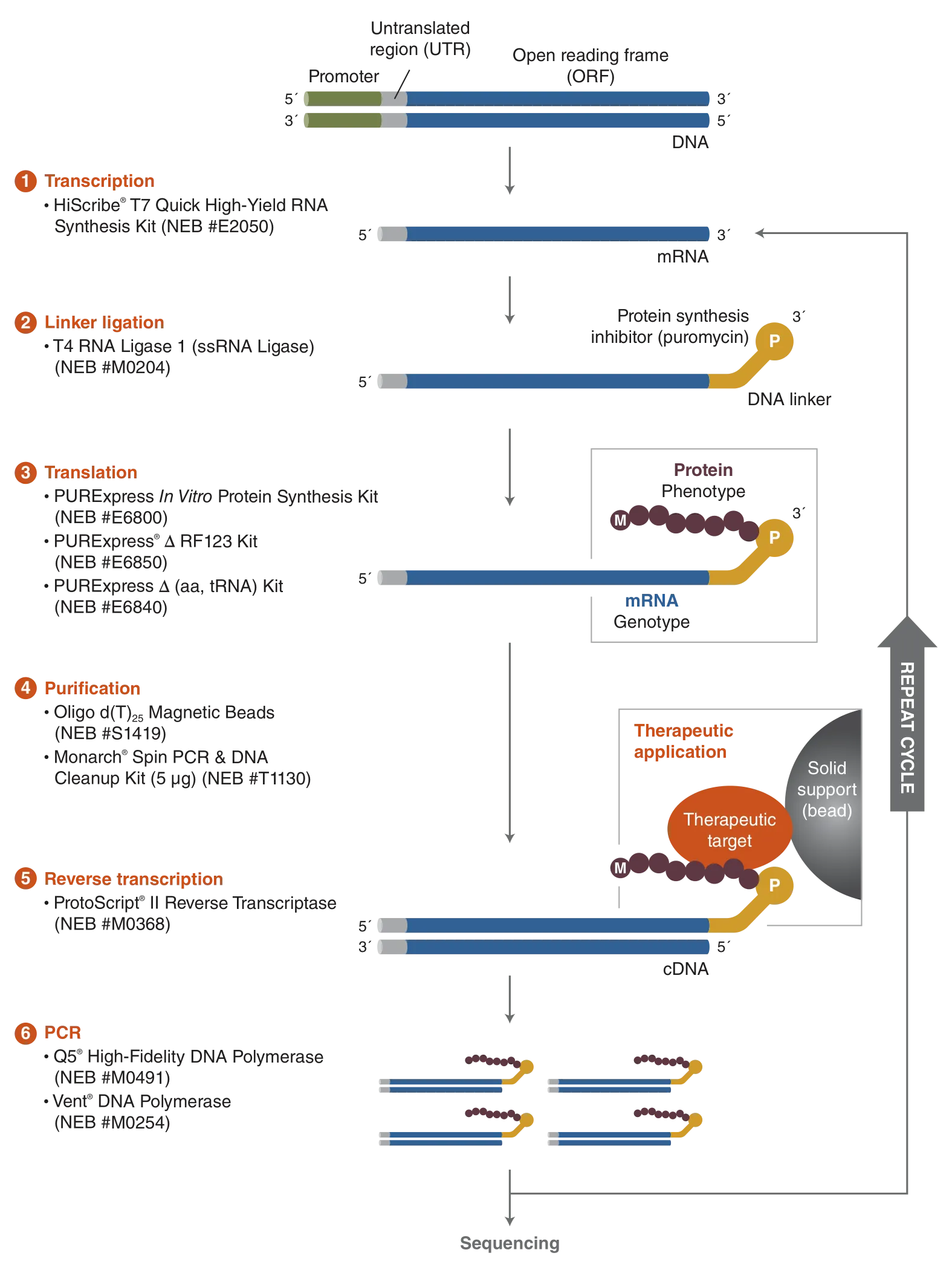
The mRNA display workflow begins by generating a library of mRNAs encoding different peptide sequences using in vitro transcription (IVT). A puromycin tag is ligated to the end of the mRNAs. Translation forms a stable peptide-mRNA complex. Peptides that bind to a target protein are selected. The mRNA from the selected complexes is PCR amplified, sequenced, and re-translated for iterative selection. The mRNA display cycle repeats to enrich for high-affinity binders.
Does enzyme quality impact mRNA display, compared to previous discovery technologies, like phage display or ribosome display?
Absolutely. In fact, enzyme quality is even more critical in mRNA display because the entire workflow is highly enzyme-dependent. Unlike phage display, where biology provides some degree of self-amplification and error tolerance, mRNA display relies on multiple sequential enzymatic steps performed entirely in vitro. Every stage — transcription, ligation, reverse transcription, PCR amplification — can introduce bottlenecks or bias. For example, low ligation efficiency directly reduces functional library size. Reverse transcripase inefficiency can preferentially cause the loss of certain sequences. PCR bias can artificially skew enrichment trends. Over multiple selection rounds, these effects can become significantly amplified. Peptifinder chooses NEB for high-quality enzymes to minimize technical noise and ensure that the enrichment signals reflect true biological selection.
What are the various applications of hits discovered by mRNA display employed by PeptiFinder?
PeptiFinder’s mRNA display platform has broad applications across therapeutics, diagnostics, and research tools because it can generate highly selective and potent peptide binders with diverse structures and functions. The most direct application is therapeutic peptide discovery, including receptor antagonists, agonists, PPI inhibitors, etc. We see strong interest in peptide-drug conjugates, peptide radioligands, targeted delivery, diagnostics, imaging and affinity reagents.
How is mRNA display evolving, and where do you see the field of peptide discovery going?
mRNA display is rapidly evolving from a powerful screening technology into an integrated discovery engine that combines molecular evolution, synthetic chemistry, structural biology, and AI-driven design. The field is moving beyond simple hit discovery toward the generation of drug-like peptide therapeutics with improved potency, selectivity, stability, permeability, and developability.
Several major trends are shaping the future of the field:
- Development of macrocyclic and conformationally constrained peptides
- Discovery of intracellular and “undruggable” targets
- Increased incorporation of noncanonical amino acids (ncAAs)
- Improved oral bioavailability and cell permeability
- AI-driven library design and hit optimization
- Functional and cell-based screening approaches
- Integration with radiopharmaceuticals, targeted delivery, and protein degrader technologies
How could enzyme engineering and workflow optimization further expand the chemical space accessible to mRNA display?
Don’t miss out on our latest NEBinspired blog releases!
- Sign up to receive our e-newsletter
- Download your favorite feed reader and subscribe to our RSS feed
Be a part of NEBinspired! Submit your idea to have it featured in our blog.