Protein Expression in Yeast
Expression of proteins in yeast is a common alternative to prokaryotic and higher eukaryotic expression. Yeast cells offer many of the advantages of producing proteins in microbes (growth speed, easy genetic manipulation, low cost media) while offering some of the attributes of higher eukaryotic systems (post translational modifications, secretory expression). Several yeast protein expression systems exist in organisms from the genera Saccharomyces, Pichia, Kluyveromyces, Hansenula and Yarrowia.
At the heart of any yeast expression system is the expression vector. Vectors that integrate into the host chromosome are most widely used because of their mitotic stability in the absence of a selection. However, episomal expression vectors exist for some yeast systems. Expression vectors typically contain a strong yeast promoter/terminator and a yeast selectable marker cassette. Most yeast vectors can be propagated and amplified in E. coli to facilitate cloning and as such, also contain an E. coli replication origin and ampicillin selectable marker. Finally, many yeast expression vectors include the ability to optionally clone a gene downstream of an efficient secretion leader (usually that of mating factor) that efficiently directs a heterologous protein to become secreted from the cell.
A growing number of engineered yeast strains are becoming available for protein expression. Strains have been described that increase yield of secreted proteins, improve the performance of certain affinity tags, reduce proteolysis, define the composition of N-glycans, and permit non-native amino acids (e.g. selenomethionine) into proteins.
The system was adapted for life sciences research by NEB and a variety of vectors and host strains in a frozen competent format are offered.
Choose Type:
- Transformation Protocol for K. lactis GG799 Competent Cells (C1001)
- Protein Expression using the K. lactis Protein Expression Kit - Simultaneous Expression of Multiple Proteins
- Protein Expression using the K. lactis Protein Expression Kit - Transformation of K. lactis GG799 cells
- Protein Expression using the K. lactis Protein Expression Kit - Identification of properly integrated cells
- Protein expression using the K. lactis Protein Expression Kit - Cloning a PCR fragment into pKLAC2 (E1000).
- Protein Expression using the K. lactis Protein Expression Kit - Identification of Multi-copy Integrants
- Protein Expression using the K. lactis Protein Expression Kit - Growth of strains for detection of secreted protein
- Protocol II: 1 M Tris-HCl Buffer Stock Solution (1 liter)
- Protein expression using the K. lactis Protein Expression Kit - Linearization of pKLAC2 for integrative transformation of K. lactis.
- Protocol I: Yeast Carbon Base Medium Powder Agar Medium with 5 mM acetamide solution (500 ml)
-
Avoid Common Obstacles in Protein Expression
Read how to avoid common obstacles in protein expression that prevent interactions with cellular machinery.
-
Why Choose the K. lactis Protein Expression Kit?
Review the advantages of the K. lactis Protein Expression Kit for rapid, high yield protein expression in yeast.
- Protein Expression & Purification Brochure
- Protein Expression and Purification Selection Chart
Feature Articles
Brochures
Selection Tools
- Sakhtah, H., Behler, J., Ali-Reynolds, A., Causey, T.B., Vainauskas, S., Taron, C.H. (2019) A novel regulated hybrid promoter that permits autoinduction of heterologous protein expression in Kluyveromyces lactos Appl Environ Microbiol; pii: e00542-19. PubMedID: 31053583
- Chuzel, L., Ganatra, M.B., Schermerhorn, K.M., Gardner, A.F., Anton, B.P., Taron, C.H. (2017) Complete genome sequence of Kluyveromyces lactis strain GG799, a common yeast host for heterologous protein expression Genome Announc; 5(30), PubMedID: 28751387
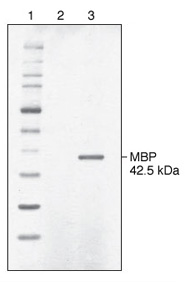
Lane 2: spent culture medium (15 µl) from wild-type K. lactis cells.
Lane 3: spent culture medium (15 µl) from K. lactis cells harboring an integrated expression cassette containing the E. coli malE gene
Products and content are covered by one or more patents, trademarks and/or copyrights owned or controlled by New England Biolabs, Inc (NEB). The use of trademark symbols does not necessarily indicate that the name is trademarked in the country where it is being read; it indicates where the content was originally developed. All other trademarks are the property of their respective owners. The use of this product may require the buyer to obtain additional third-party intellectual property rights for certain applications. For more information, please email busdev@neb.com.
This product is intended for research purposes only. This product is not intended to be used for therapeutic or diagnostic purposes in humans or animals.