SHuffle® strains for the expression of multi-disulfide bonded and difficult-to-express proteins
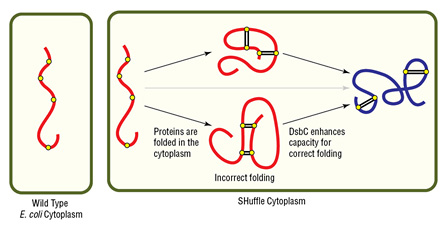
The redox state of the cytoplasm of eukaryotic and prokaryotic cells is reducing, due to the presence of numerous disulfide bond reductases, such as thioredoxins and glutaredoxins. As such, any disulfide bond formed between two cysteines will quickly and efficiently be reduced back to its thiolate state. To form stable disulfide bonds within proteins, disulfide bond formation is typically compartmentalized outside of the reducing cytoplasm. [see animation 2 of 4, at right] In eukaryotes, disulfide bond formation is catalyzed by Protein Disulfide Bond Isomerase (PDI) in the endoplasmic reticulum (ER), whereas in prokaryotes, disulfide bond formation is catalyzed by DsbA in the periplasm. [see animation 3 of 4, at right] An inherent problem in the process of disulfide bond formation is mis-pairing (mis-oxidation) of cysteines, which can cause misfolding, aggregation and, ultimately, result in low yields during protein production. Proteins that are mis-oxidized must be repaired and disulfide bonds must be shuffled back to their correctly oxidized native state. This is achieved by PDI in eukaryotes and DsbC by prokaryotes.
There are several options for expressing proteins that require disulfide bonding for proper folding and function. The E. coli strain SHuffle® has been genetically engineered for the cytoplasmic production of disulfide-bonded proteins. Genetic deletion of the two (glutaredoxin and thioredoxin) reducing pathways in E. coli has resulted in a mutant strain with diminished capacity to reduce proteins, and an increased capacity to oxidize cytoplasmically-expressed proteins. Additionally, these cells have been engineered to express the disulfide bond isomerase DsbC in the cytoplasm, further enhancing the capacity for and fidelity of disulfide bond formation in this host. [see animation 4 of 4, at right]
| Strain | NEB # | Characteristics | Drug Resistance |
|---|---|---|---|
| SHuffle Express Competent E. coli | C3028 |
|
Spec |
| SHuffle T7 Express Competent E. coli | C3029 |
|
Spec* |
| SHuffle T7 Express lysY Competent E. coli | C3030 |
|
Cam, Spec* |
| SHuffle T7 Competent E. coli | C3026 |
|
Str, Spec |
* Resistance to low levels of steptomycin may be observed.
It is also possible to use eukaryotic protein secretion or cell-free expression strategies to achieve proper disulfide bonding of proteins. For example, secretion of a target protein into the oxidative ER environment of yeast, mammalian or insect cells will permit a nascent protein the opportunity to fold in and to have access to PDI. Cell-free strategies can also be employed using systems like PURExpress® with Disulfide Bond Enhancer that contains components that improve in vitro formation of disulfide bonds.Choose Type:
- What are the strain properties of Lemo21(DE3) competent E. coli?
- Where can I find more detailed FAQs for the K. lactis Protein Expression Kit?
- What systems does NEB offer for protein expression and purification?
- Which SHuffle® strain should I use?
- How do SHuffle® strains aid in cytoplasmic disulfide bond formation?
- What is LysY?
- What applications are SHuffle® strains useful for?
- High Efficiency Transformation Protocol
- Protein Expression with T7 Express strains
- Expression Using SHuffle (C3030)
- 5 Minute Transformation Protocol (C3026)
- Transformation Protocol (#C3029, #C3026, #C3028 and #C3030)
- 5 Minute Transformation Protocol (C3030)
- 5 Minute Transformation Protocol (C3029)
- Expression Using SHuffle (C3026)
- Expression Using SHuffle (C3029)
- Transformation of SHuffle® Competent Cell Strains
- E coli Lemo21 DE3 A T7 RNA Polymerase-based protein overexpression platform for routine and difficult targets
- Protein Expression with T7 Express Strains
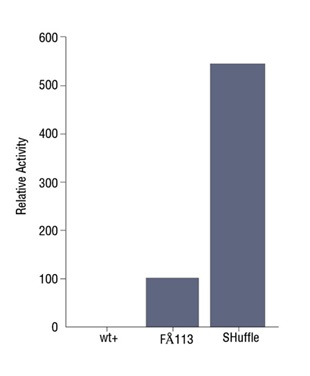
- Use of the PURExpress® in vitro Protein Synthesis Kit, Disulfide Bond Enhancer and SHuffle® Competent E. coli for heterologous in vitro and in vivo cellulase expression.
- Using the PURExpress® In Vitro Protein Synthesis Kit for Heterologous In Vitro Expression and Functional Screening of FMN-dependent Oxidoreductase Variants
- NEBExpress® Cell-free E. coli Protein Synthesis System
-
Avoid Common Obstacles in Protein Expression
Read how to avoid common obstacles in protein expression that prevent interactions with cellular machinery.
-
The Future of Cell-Free Protein Synthesis
Cell-free protein synthesis has the potential to become one of the most important high throughput technologies for functional genomics and proteomics.
-
Over 40 years in protein expression and purification – a historical perspective
This article provides an overview of the advances in protein expression and purification methodology over the past 40 years.
- Competent Cell Brochure
- Protein Expression & Purification Brochure
- Protein Expression and Purification Selection Chart
- Competent Cell Product Comparison
Feature Articles
Brochures
Selection Tools
- Agrawal, A., Bisharyan, Y., Papoyan, A, Bednenko, J., Cardarelli, J., Yao, M., Clark, T., Berkmen, M., Ke, N., Colussi, P. (2019) Fusion to Tetrahymena thermophila granule lattice protein 1 confers solubility to sexual stage malaria antigens in Escherichia coli. Protein Expr Purif; 153, 7-17. PubMedID: 30081196, DOI: 10.1016/j.pep.2018.08.001.
- Manta, Bruno; Berkmen, Mehmet; (2019) Disulfide Bond Formation in the Periplasm of Escherichia coli. EcoSal Plus; PubMedID: 30761987, DOI: 10.1128/ecosalplus.ESP-0012-2018.
- Leith, E.M., O'Dell, W.B., Ke, N., McClung, C., Berkmen, M., Bergonzo, C., Brinson, R.G., Kelman, Z (2019) Characterization of the internal translation initiation region in monoclonal antibodies expressed in Escherichia coli J Biol Chem; 294(48), 18046-18056.. PubMedID: 31604819, DOI: 10.1074/jbc.RA119.011008
- Reddy, P.T., Brinson, R.G., Hoopes, J.T., McClung, C., Ke, N., Kashi, L. (2018) Platform development for expression and purification of stable isotope labeled monoclonal antibodies in Escherichia coli. mAbs MAbs; 10 (7), 992-1002. PubMedID: 30060704, DOI: 10.1080/19420862.2018.1496879
- Ke, Na; Berkmen, Mehmet; Ren, Guoping; (2017) A water-soluble DsbB variant that catalyzes disulfide-bond formation in vivo Nat Chem Biol; 13, 1022-1028. PubMedID: 28628094, DOI: 10.1038/nchembio.2409
- Ren, G., Ke, N. and Berkmen, M. (2016) Use of the Shuffle Strains in Production of Proteins. Curr Protoc Protein Sci; Aug 1, 1;85:5.26.1-5.26.21.. PubMedID: 27479507 , DOI: 10.1002/cpps.11.
- Anton, B.P., Fomenkov, A., Raleigh, E.A. and Berkmen, M. (2016) Complete Genome Sequence of the Engineered Escherichia coli SHuffle Strains and Their Wild-Type Parents Genome Announc; Mar 31;4(2), PubMedID: 27034504, DOI: 10.1128/genomeA.00230-16.
- Robinson, M.-P., Ke, N., Lobstein, J., Peterson, C., Szkodny, A., Mansell, T.J., Tuckey, C., Riggs, P.D., Colussi, P.A., Noren, C.J., Taron, C.H., Delisa, M.P., Berkmen, M. (2015) Efficient expression of full-length antibodies in the cytoplasm of engineered bacteria Nat Commun; (6)8072, PubMedID: 26311203, DOI: 10.1038/ncomms9072.
- Chatelle C, Kraemer S, Ren G, Chmura H, Marechal N, Boyd D, Roggemans C, Ke N, Riggs P, Bardwell J, Berkmen M (2015) Converting a Sulfenic Acid Reductase into a Disulfide Bond Isomerase Antioxid Redox Signal; 26191605. PubMedID: 26191605, DOI: 10.1089/ars.2014.6235
- Shouldice, S.R., Cho, S.H., Boyd, D., Heras, B., Eser, M., Beckwith, J., Riggs, P., Martin, J.L.and Berkmen, M. (2010) In vivo oxidative protein folding can be facilitated by oxidation-reduction cycling. Mol Microbiol; 75(1), 13-28. PubMedID: 19968787
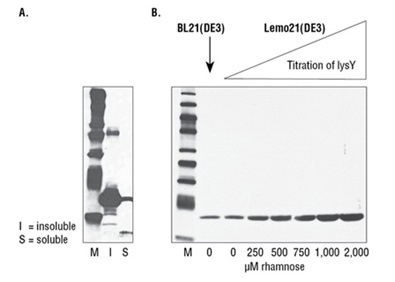
B) Soluble fractions of B. malayi protein expressed at 30°C in Lemo21 (DE3).
Products and content are covered by one or more patents, trademarks and/or copyrights owned or controlled by New England Biolabs, Inc (NEB). The use of trademark symbols does not necessarily indicate that the name is trademarked in the country where it is being read; it indicates where the content was originally developed. All other trademarks are the property of their respective owners. The use of this product may require the buyer to obtain additional third-party intellectual property rights for certain applications. For more information, please email busdev@neb.com.
This product is intended for research purposes only. This product is not intended to be used for therapeutic or diagnostic purposes in humans or animals.