Site Directed Mutagenesis
Site-directed mutagenesis (SDM) is a method to create specific, targeted changes in double stranded plasmid DNA. There are many reasons to make specific DNA alterations (insertions, deletions and substitutions), including:
- To study changes in protein activity that occur as a result of the DNA manipulation.
- To select or screen for mutations (at the DNA, RNA or protein level) that have a desired property
- To introduce or remove restriction endonuclease sites or tags
Method Overview:
SDM is an in vitro procedure that uses custom designed oligonucleotide primers to confer a desired mutation in a double-stranded DNA plasmid. Formerly, a method pioneered by Kunkel (Kunkel, 1985) that takes advantage of a strain deficient in dUTPase and uracil deglycosylase so that the recipient E. coli degrades the uracil-containing wild-type DNA was widely used. Currently, there are a number of commercially available kits that also require specific modification and/or unique E. coli strains (for example, the Phusion® Site-Directed Mutagenesis from Thermo and the GeneArt® system from Life). The most widely-used methods do not require any modifications or unique strains and incorporate mutations into the plasmid by inverse PCR with standard primers. For these methods, primers can be designed in either an overlapping (QuikChange®, Agilent) or a back-to-back orientation (Q5® Site-Directed Mutagenesis Kit) (Figure 1). Overlapping primer design results in a product that will re-circularize to form a doubly-nicked plasmid. Despite the presence of these nicks, this circular product can be directly transformed into E. coli, albeit at a lower efficiency than non-nicked plasmids. Back-to-back primer design methods not only have the advantage of transforming non-nicked plasmids, but also allow exponential amplification to generate significantly more of the desired product (Figure 2). In addition, because the primers do not overlap each other, deletions sizes are only limited by the plasmid and insertions are only limited by the constraints of modern primer synthesis. Currently, by splitting the insertion between the two primers, insertions up to 100 bp can routinely be created in one step using this method.
Before primers are designed, it is important to determine which mutagenesis workflow is to be used. Here we present a comparison of three commercially available kits (Figure 3) and a brief description of important features.
Before you plan your next SDM experiment, be sure to read through our list of important experimental considerations.
Kunkel, T.A. (1985) Proc Natl Acad Sci U.S.A. 82(2):488-492. PMID: 3881765
Figure 1: Site-specific mutagenesis proceeds in less than 2 hours.
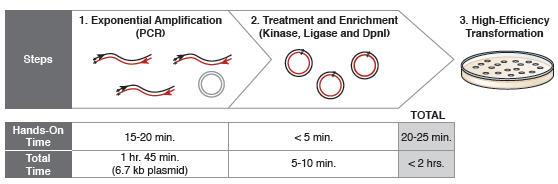
Figure 2: Q5 Site-Directed Mutagenesis Kit Overview.
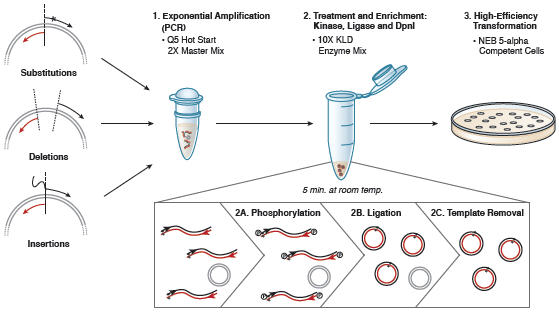
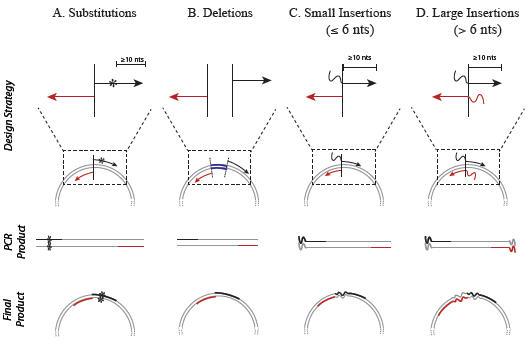
Figure 3: Primer Design for the Q5 Site-Directed Mutagenesis Kit
Choose Type:
- Molecular Cloning Technical Guide
- Troubleshooting Guide for Cloning
Brochures
Troubleshooting Guides
- Yafeng Li, Delu Song, Ying Song, Liangliang Zhao, Natalie Wolkow, John W Tobias, Wenchao Song, Joshua L Dunaief (2015) Iron-induced Local Complement Component 3 (C3) Up-regulation via Non-canonical Transforming Growth Factor (TGF)-β Signaling in the Retinal Pigment Epithelium. J Biol Chem; 290, 11918-34. PubMedID: 25802332, DOI: 10.1074/jbc.M115.645903
Products and content are covered by one or more patents, trademarks and/or copyrights owned or controlled by New England Biolabs, Inc (NEB). The use of trademark symbols does not necessarily indicate that the name is trademarked in the country where it is being read; it indicates where the content was originally developed. All other trademarks are the property of their respective owners. The use of this product may require the buyer to obtain additional third-party intellectual property rights for certain applications. For more information, please email busdev@neb.com.
This product is intended for research purposes only. This product is not intended to be used for therapeutic or diagnostic purposes in humans or animals.