T7 Expression
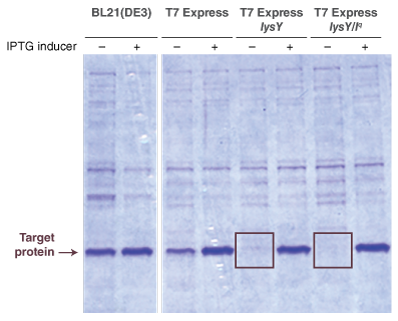
Within the realm of E. coli expression, the T7 system is the most popular approach for producing recombinant protein. In this system, the target gene is cloned into an expression vector downstream of the T7 promoter and this construct is introduced into a T7 expression host. T7 expression hosts such as DE3 prophage strains or T7 Express strains carry a chromosomal copy of the phage T7 RNA polymerase gene. When inducer is added, T7 RNA polymerase is expressed and becomes dedicated to target gene transcription. T7 expression is often very robust but may suffer from undesirable basal (non-induced) transcription especially in DE3 strains. Regulation of IPTG-induced T7 expression is accomplished by co-expressing the lac repressor from a plasmid or a host-encoded lacI gene and by co-expressing T7 lysozyme, the natural inhibitor of T7 RNA polymerase activity. T7 lysozyme may be expressed from pLysS or pLysE plasmids or a variant T7 lysozyme may be expressed from the lysY gene present within multiple NEB protein expression strains. The lysY gene product lacks amidase (lysozyme) activity against the E. coli cell wall while retaining the ability to inhibit basal T7 RNA polymerase activity.
Choose Type:
- What are the strain properties (C2566)?
- Is T7 Express (NEB #C2566H and NEB #C2566I) compatible with auto-induction procedures?
- What are the strain properties (C2527)?
- What is the difference between T7 Express (NEB #C2566H/I) and BL21(DE3) (NEB #C2527H/I)?
- Can the NEBExpress Competent E.coli (High Efficiency) be used for the expression of constructs containing a T7 promoter?
-
Avoid Common Obstacles in Protein Expression
Read how to avoid common obstacles in protein expression that prevent interactions with cellular machinery.
- Competent Cell Brochure
- Protein Expression & Purification Brochure
- DNA Sequences and Maps Tool
- Competent Cell Selection Guide
- Competent Cell Product Comparison
Feature Articles
Brochures
Web Tools
Selection Tools
- Agrawal, A., Bisharyan, Y., Papoyan, A, Bednenko, J., Cardarelli, J., Yao, M., Clark, T., Berkmen, M., Ke, N., Colussi, P. (2019) Fusion to Tetrahymena thermophila granule lattice protein 1 confers solubility to sexual stage malaria antigens in Escherichia coli. Protein Expr Purif; 153, 7-17. PubMedID: 30081196, DOI: 10.1016/j.pep.2018.08.001.
- Leith, E.M., O'Dell, W.B., Ke, N., McClung, C., Berkmen, M., Bergonzo, C., Brinson, R.G., Kelman, Z (2019) Characterization of the internal translation initiation region in monoclonal antibodies expressed in Escherichia coli J Biol Chem; 294(48), 18046-18056.. PubMedID: 31604819, DOI: 10.1074/jbc.RA119.011008
- Reddy, P.T., Brinson, R.G., Hoopes, J.T., McClung, C., Ke, N., Kashi, L. (2018) Platform development for expression and purification of stable isotope labeled monoclonal antibodies in Escherichia coli. mAbs MAbs; 10 (7), 992-1002. PubMedID: 30060704, DOI: 10.1080/19420862.2018.1496879
- Robinson, M.-P., Ke, N., Lobstein, J., Peterson, C., Szkodny, A., Mansell, T.J., Tuckey, C., Riggs, P.D., Colussi, P.A., Noren, C.J., Taron, C.H., Delisa, M.P., Berkmen, M. (2015) Efficient expression of full-length antibodies in the cytoplasm of engineered bacteria Nat Commun; (6)8072, PubMedID: 26311203, DOI: 10.1038/ncomms9072.
E. coli Hosts
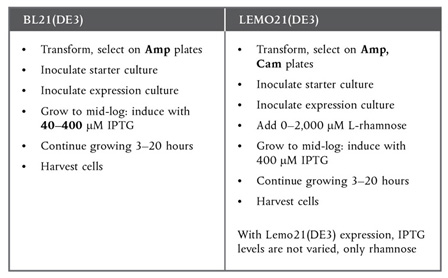
Protein expression with Lemo21(DE3) is very similar to BL21(DE3), with only a few minor changes.
Products and content are covered by one or more patents, trademarks and/or copyrights owned or controlled by New England Biolabs, Inc (NEB). The use of trademark symbols does not necessarily indicate that the name is trademarked in the country where it is being read; it indicates where the content was originally developed. All other trademarks are the property of their respective owners. The use of this product may require the buyer to obtain additional third-party intellectual property rights for certain applications. For more information, please email busdev@neb.com.
This product is intended for research purposes only. This product is not intended to be used for therapeutic or diagnostic purposes in humans or animals.