mRNA Synthesis Democratized with Open-source Approach by BASE Facility Researchers
Posted on Tuesday, July 29, 2025
By
Topic: What is Trending in Science


New England Biolabs Sales Manager of Australia & New Zealand, Jenny Brown, interviewed Timothy Mercer, Professor at the University of Queensland and Director of the BASE facility and Seth Cheetham, Associate Professor at the University of Queensland and Deputy Director of the BASE facility. They recently published a novel protocol for mRNA synthesis in Nature Protocols utilizing standard laboratory techniques and equipment to produce high-purity mRNA suitable for in vitro and in vivo preclinical studies.
Jenny Brown:
Please tell us about the BASE facility.
Seth Cheetham:
The BASE facility is a national facility that provides researchers around Australia with high-quality mRNA. We provide an end-to-end service, from mRNA design through to final formulation. This enables people to start using mRNA in their research to develop new vaccines and therapies.
In addition to supporting scientists with mRNA, we also have our own internal research program, where we explore new mRNA manufacturing methods, quality control of mRNA, new approaches to deliver mRNA to tissues, and develop our own pipeline of mRNA candidates.
Timothy Mercer:
Everyone thinks about mRNA in terms of medicines, vaccines and therapies, but scientists are increasingly realizing that mRNA makes a fantastic experimental reagent. We see the scientific community increasingly adopting mRNA for use in their experiments, especially in fields such as immunology and neuroscience, that have been otherwise difficult to explore.
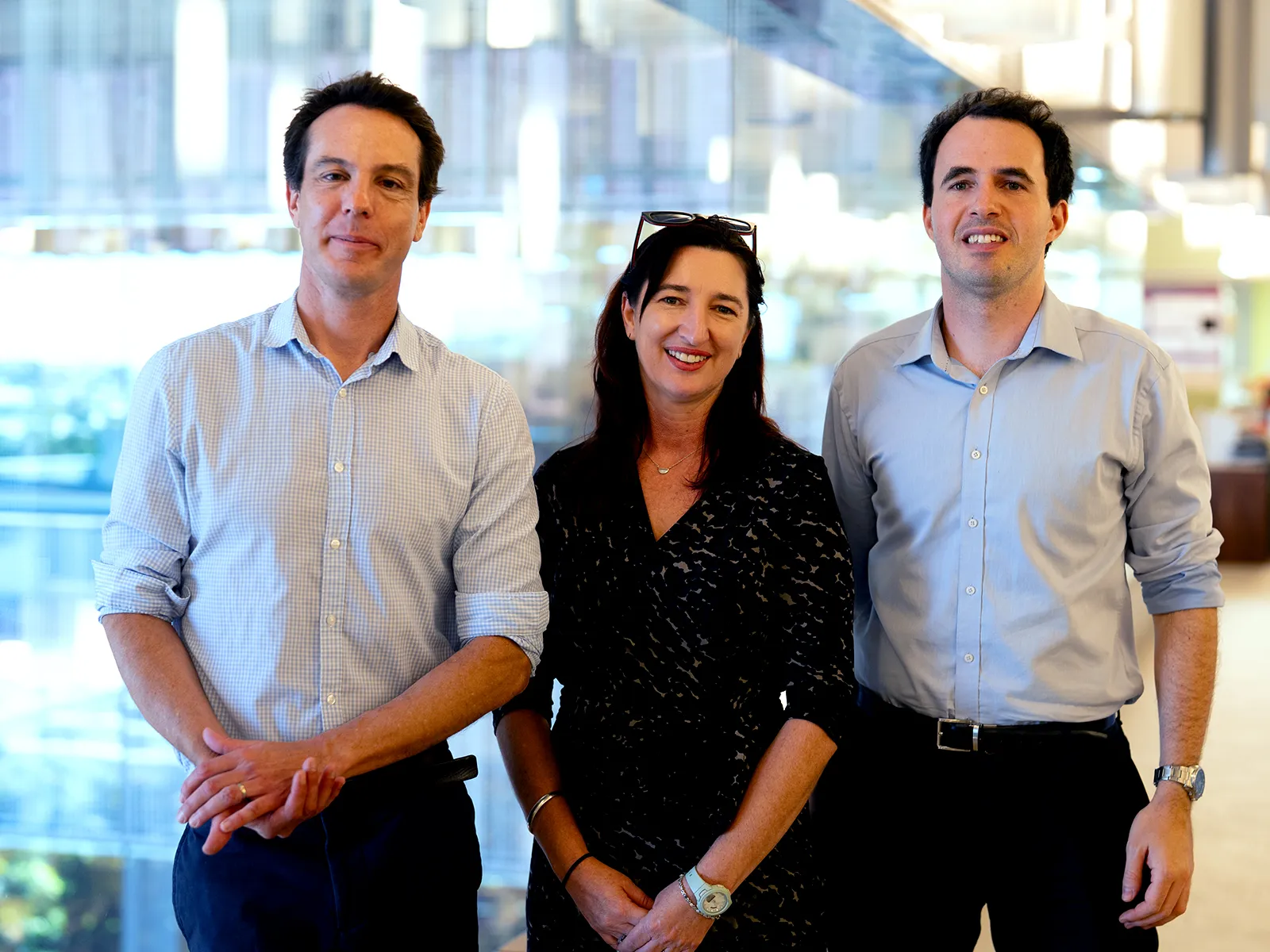
BASE facility interviewees with NEB interviewer Jenny Brown. From left to right: Timothy Mercer, Jenny Brown, Seth Cheetham. Photo courtesy of Luke Brown, Run Media.
Jenny Brown:
What was the challenge in mRNA manufacturing that you were looking to address in the development of this protocol?
Seth Cheetham:
So far, mRNA manufacturing has been regarded as being a very specialized approach, which has only been accessible through specialized facilities such as the BASE facility. What we wanted to do was to develop an open-source approach to democratize mRNA access. This allows researchers around the world to produce high-quality mRNA in their own lab, and develop new vaccines and therapies.
Timothy Mercer:
This protocol has really been developed with the researcher in mind. It's designed to be able to produce mRNA in a standard laboratory, using standard equipment, in an affordable manner. First, we design the mRNA using the mRNArchitect software. After that, we use a PCR approach to prepare that DNA template, which is then used for in vitro transcription to synthesize the mRNA. Finally the mRNA can be formulated within the lipid nanoparticle at the end for in vivo delivery, or within your in vitro experiments, depending on what that final application is.
Jenny Brown:
Producing mRNA can be technically challenging, what manufacturing challenges do labs encounter when producing mRNA?
Seth Cheetham:
One of the issues in mRNA manufacturing was that it relied on plasma DNA, which is extracted from bacterial cells.
Timothy Mercer:
A big challenge for plasmids is the bioburden, the contamination that they can sometimes introduce within the process. When you're making mRNA, you want to remove any of those contaminants, and so excluding the plasmid removes one of those primary sources of contaminants.
Seth Cheetham:
We wanted to move away from this approach by using synthetic templates. So, we used PCR amplification to produce our templates either from a synthetic piece of DNA or from plasmid, which removes the need to grow large amounts of bacteria. This makes the process both cleaner and faster, and results in a higher quality mRNA.
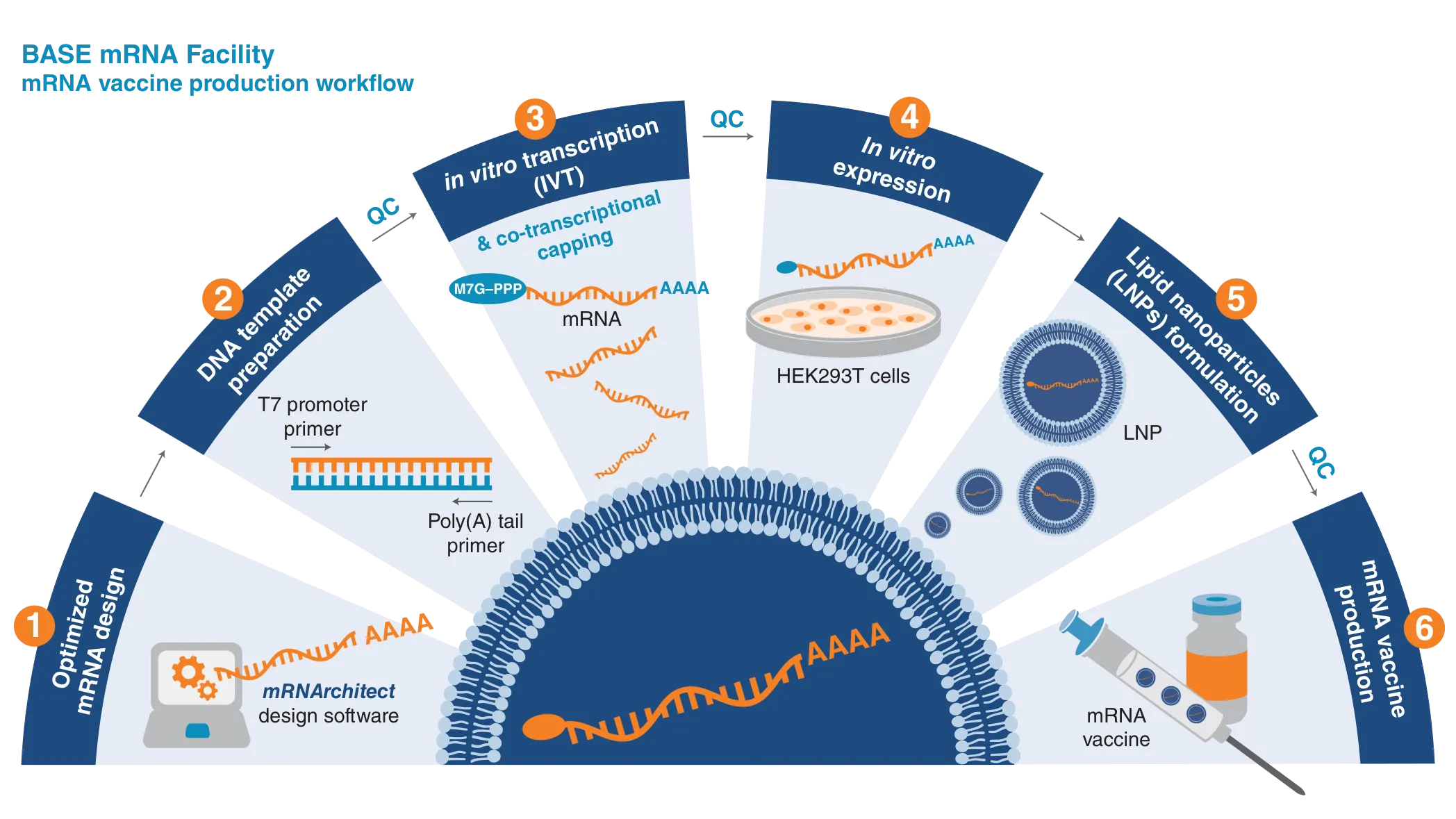 This novel mRNA synthesis workflow relies on PCR for DNA template preparation, which is then used for in vitro transcription to synthesize the mRNA. Finally the mRNA can be formulated within the lipid nanoparticle at the end for final applications.
Jenny Brown:
Who specifically do you think it will benefit the most? What type of customer or researcher?
Timothy Mercer:
I think all researchers have a lot to benefit from mRNA. I envision mRNA assuming a position alongside plasmids and proteins in terms of experimental tool. We support a lot of scientists who work with non-dividing or fickle or difficult cells, and they are getting really good results using mRNA. It's a really powerful tool to express genes in those difficult cell lines experimental models.
Jenny Brown:
What global impacts do you see this protocol having?
Timothy Mercer:
We hope that this protocol allows people to start adopting and producing mRNA within their lab. In some ways, it demystifies the process of making mRNA. This protocol is pretty easy-to-follow and provides guidelines to make sure you produce good, high-quality and non-contaminated mRNA. We just hope it gets adopted by different scientists all over the world, so they can start generating their own mRNA and start using it in their experiments.
Jenny Brown:
What were the key elements in enabling the development of this protocol?
Seth Cheetham:
This work was enabled by support from Therapeutic Innovation Australia, which provides support from the Federal Government body, together with the University of Queensland to start the BASE facility, which was, at the time, Australia's first mRNA capability. Through the acquisition of specialized equipment and also the expertise from our team, we were able to start developing this protocol and are now able to share it with the entire research community.
Also, for a long time we have had a very close collaborative relationship with NEB, who were one of the leaders in the development of enzymes and raw materials that are used in mRNA production. We've been collaborating with them both as a partner for the production of mRNA and also to enhance mRNA innovation — so new approaches to manufacturing and quality control of mRNA products.
NEB has an almost academic philosophy in which they're really interested in exploring lots of new and innovative ways of doing things. So, working with a company like that is really a natural match for us coming from the university, because they actually have a real emphasis on innovation and excellence in mRNA manufacture.
Jenny Brown:
Could you tell me about the origin story of the BASE facility?
Timothy Mercer:
The BASE facility was set up in 2021 towards the end of the pandemic, when the Australian government recognized the transformative potential of mRNA. They wanted to set up a facility that could help researchers all across Australia to develop new mRNA vaccines and therapies.
Since then, the field of mRNA is maturing a lot, and we are developing new and novel processes to make mRNA, and moving a little away from the legacy processes where we started. I think this protocol is a good example of that, where we've essentially developed a quick, cell-free approach to make small batches of high-quality mRNA.
Jenny Brown:
So, where do you see mRNA going in the future?
Timothy Mercer:
mRNA is a transformative technology. I think mRNA has a huge amount of potential as a scientific tool. We talk about it a lot in terms of mRNA vaccines and therapies, but we're increasingly seeing it used by a whole bunch of different scientists in a whole bunch of different applications. And I think that breadth, that use of mRNA in so many different ways, that will, ultimately underpin the development of many new mRNA medicines.
Don’t miss out on our latest NEBinspired blog releases!
- Sign up to receive our e-newsletter
- Download your favorite feed reader and subscribe to our RSS feed
Be a part of NEBinspired! Submit your idea to have it featured in our blog.