Quality at NEB
- NEB’s quality certifications (ISO 13485:2016 and ISO 9001:2015), quality assurance practices, and GMP-grade* manufacturing
- Product lifecycle tracking practices (expiration dating and barcoding)
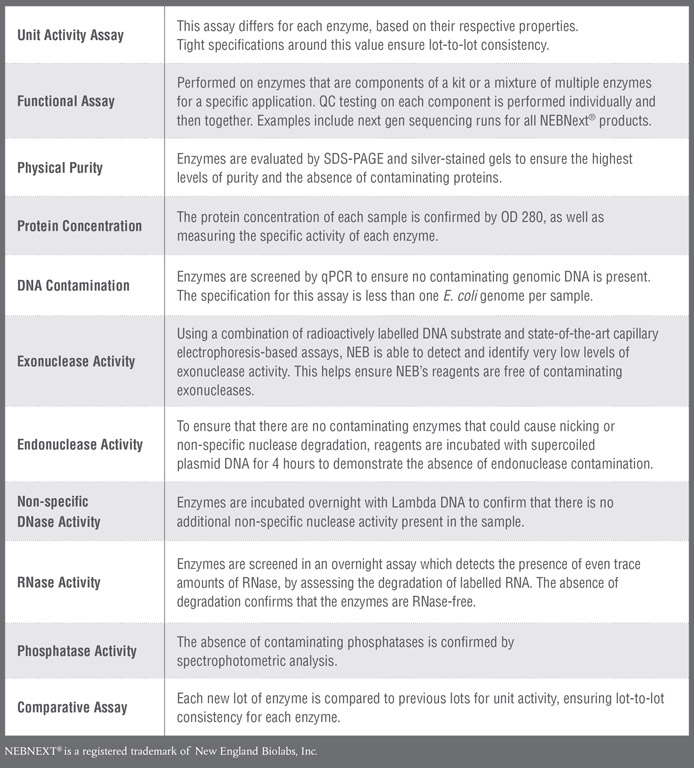
- Stringent quality controls
- Examples of product quality across multiple competitors
For questions about NEB’s quality processes for standard and custom products, please contact info@neb.com.
NEB holds both ISO 13485: 2016 and ISO 9001: 2015 certifications at its facilities in Ipswich, Rowley and Beverly, MA (USA); Germany, Singapore, Hitchin Herts and Oxfordshire (UK). Learn more about our ISO certifications on our Certifications page.
To better serve the needs of customers in regulated markets, NEB operates a state-of-the-art 43,000 sq. ft. production facility in Rowley, MA for the manufacture of GMP-grade* materials – approximately 15 minutes from our main campus in Ipswich, MA, USA. This animal-free purpose-built facility includes Quality Control and Production functions ranging from a shipping/receiving area and dedicated warehouse, to separate inoculation preparation, fermentation, purification and fill suites.
- Product Certificates of Origin are available upon request
- Established validation programs to ensure product outputs and specifications are met through Continuous Process Verification and validation where outputs cannot be subsequently verified.
- Change Management and Customer Notification of Changes
- Use of a validated 21CFR Part 11-compliant electronic Quality Management Software (eQMS) for Quality records,document control, training, complaints, non-conformances, CAPA, audits, and more.
New England Biolabs has a policy of assigning expiration dates to many of our enzymes and reagents. This policy is designed to satisfy the needs of a growing number of our customers who require such information to meet their regulatory requirements. Enzymes should be stored long-term at the recommended temperature (most often -20°C; some enzymes have alternate recommended storage temperatures, such as -80°C). During use, enzymes should be stored on ice, and then returned to their long term storage conditions promptly after use.
Our expiration dates have been developed as a result of many years of experience with our products and represent a minimum guaranteed life expectancy for full activity of a given product. It is not the intent of this dating policy to imply that a product will necessarily lose activity after the expiration date. In fact, many of our enzymes will retain significant, if not full, activity for many months or even years after the expiration date. For many basic research applications, enzyme vials may be suitable for use well past their stated expiration date. Disposal and or continued use of enzymes past their expiration dates should be at the discretion of the end user.
NEB uses a barcoding system for catalog products that allows enhanced tracking of product within NEB, increases the accuracy of our shipping operations and also provides expanded product information for each shipped item.
The barcode (see image below) is based on Code 128 symbology, consists of a six-digit catalog number (eg., R0650S), an eight-digit lot number (eg., 10008628), a four-digit assay date (eg., 1803), and a four-digit expiration date (eg., 2003). For the four pieces of coded information (cat #, lot #, assay date, exp. date), the details are as follows:
- catalog # - the standard six-digit system is our standard catalog number.
- lot # - NEB utilizes a system-assigned, non-intelligent lot number to identify every unique packaging run. This lot number is printed on the outside of the package and embedded in the package barcode.
- assay date - this is a four-digit sequence, YYMM; for example, 1803 would indicate an assay date of March 2018.
- expiration date - this is a four-digit sequence, YYMM; for example, 2003 would indicate an expiration date of March 2020.

A range of standard Quality Controls may be run for each product.
- Examples of stability testing methodology include:
– Accelerated testing
– Freeze/thaw testing
– Rotational stress
– Real-time testing
- New product shelf life is set based on accelerated testing, performance of similar products, and verified by real-time testing.
- Fully packaged retains are stored under controlled conditions for one year past expiration date.
- Proprietary methods are developed by Research, Applications and Product Development scientists, and verified by Product Managers and the Quality Control lab.
- Availability of Certificates of Analysis, Certificates of Animal Origin and Product Specifications for custom or catalog products
- Lot-to-lot reproducibility is maintained by in-process monitoring and measurements, SAP managed production Bill of Materials, Production controls, activity measurement and functional and product specification testing.
Extreme purity with NEB's T4 DNA Ligase
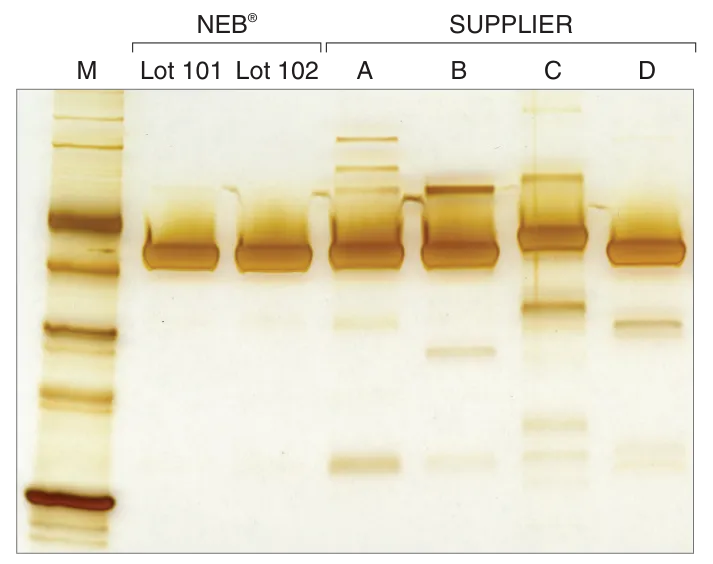
T4 DNA Ligase competitor study - nuclease contamination
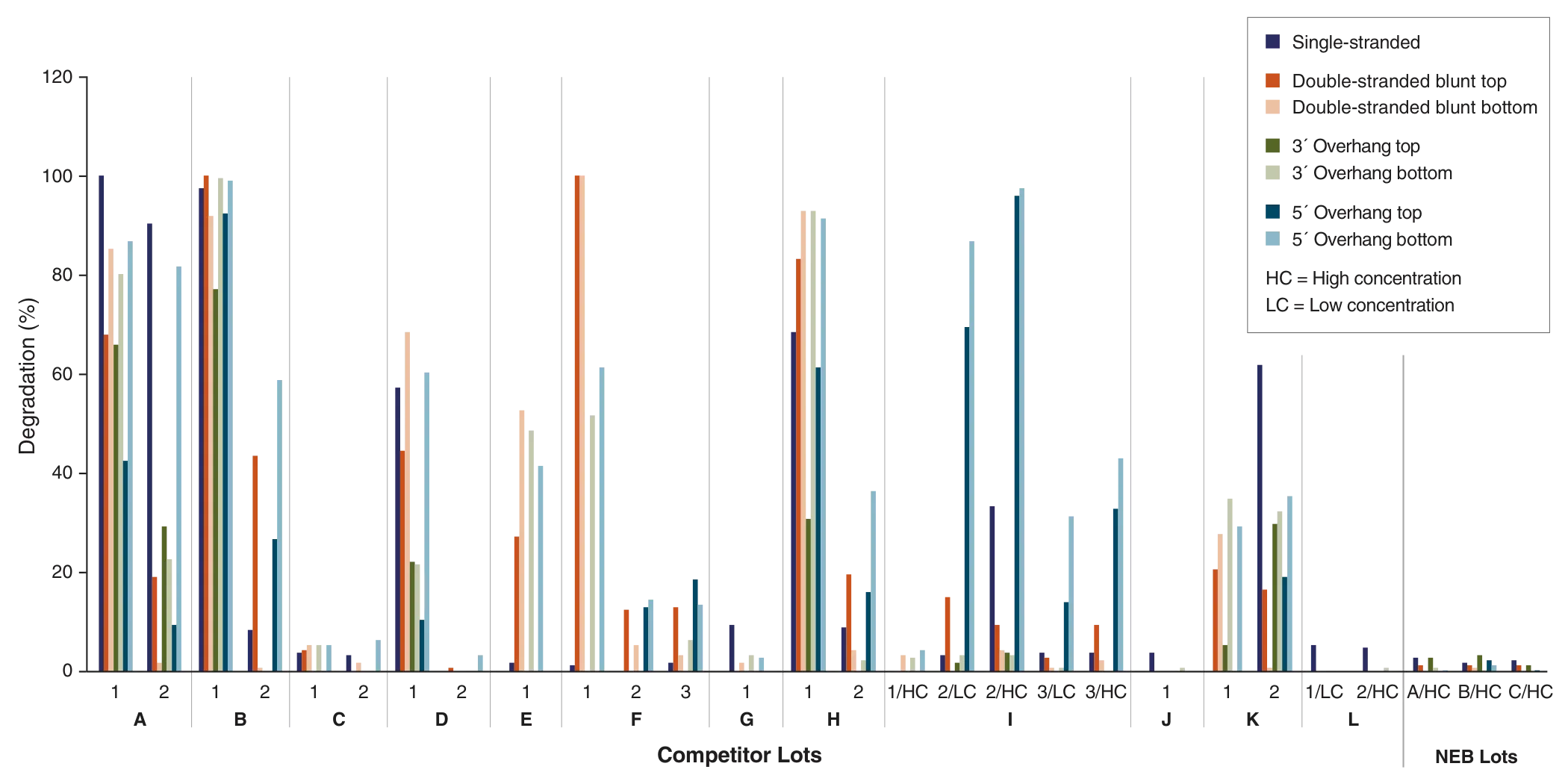
Restriction enzyme competitor study: Nuclease contamination
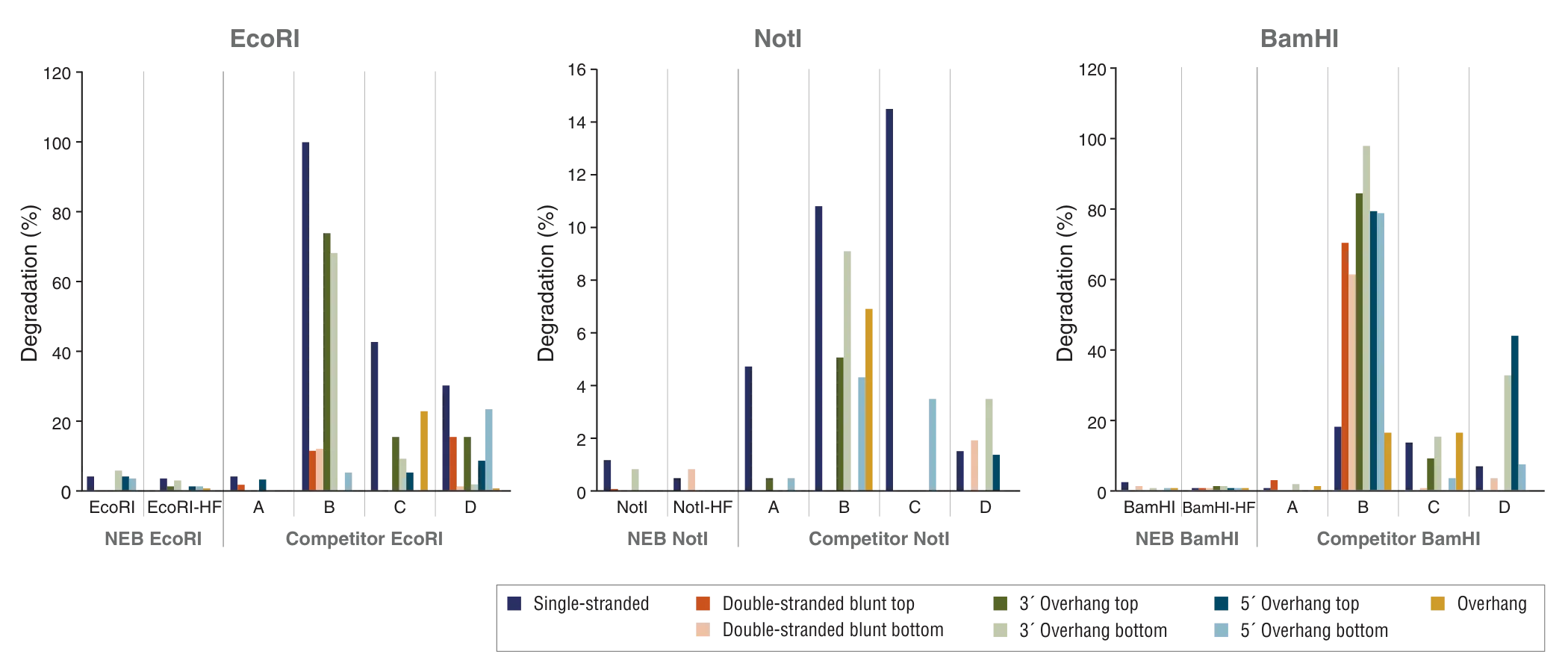
EcoRI, NotI, and BamHI from multiple suppliers were tested in reactions containing a fluorescent labeled single-stranded, double-stranded blunt, 3´ overhang or 5´ overhang containing oligonucleotides. The percent degradation is determined by capillary electrophoresis and peak analysis. The resolution is at the single nucleotide level.
* “GMP Grade” and “GMP-grade” are branding terms NEB uses to describe products manufactured or finished at NEB’s Rowley facility. The Rowley facility was designed to manufacture products under more rigorous infrastructure and process controls to achieve more stringent product specifications and customer requirements. Products manufactured at NEB’s Rowley facility are manufactured in compliance with ISO 9001 and ISO 13485 quality management system standards. However, at this time, NEB does not manufacture or sell products known as Active Pharmaceutical Ingredients (APIs), nor does NEB manufacture its products in compliance with all of the Current Good Manufacturing Practice regulations.