Building Genes Faster and Cheaper with Decentralized Workflows
Posted on Wednesday, November 19, 2025
By
Topic: What is Trending in Science
In synthetic biology, great ideas often emerge faster than the tools needed to enable them. For example, up until now, DNA synthesis has limited how quickly and affordably researchers turn their designs into functional constructs. Researchers depend on commercial vendors for custom DNA, which is reliable but can be slow and somewhat restrictive. It can delay experiments by several weeks, inflate costs and often fails for sequences with high GC content, repeats or other complex regions.
A recent study from our scientists at New England Biolabs describes a parallelized, decentralized workflow for gene construction that delivers sequence-confirmed constructs in as little as four days at a fraction of the outsourcing cost. By integrating the NEBridge SplitSet® Lite High-Throughput web tool with NEB's Data-Optimized Assembly Design (DAD) and NEBridge® Golden Gate Assembly, the method enables labs to perform large-scale, high-fidelity DNA construction in-house, making advanced parallel gene assembly (PGA) methods accessible to a broader range of research labs.
The Need for Decentralization
Centralized DNA synthesis has served researchers well, but its limitations — primarily stemming from chemical synthesis methods and homology-based construction techniques — are becoming increasingly apparent:
- Turnaround times slow down iterative design-build-test cycles, restricting the pace of discovery.
- High costs put ambitious, large-scale projects out of reach for many labs.
- Constructs with high GC content, long repeats or secondary structures are often flagged as "not synthesizable."
- Dependence on external providers can create bottlenecks that constrain academic research and biotech innovation.
A decentralized alternative — where labs can construct DNA independently, quickly and cost-effectively — addresses all these limitations. Lund and colleagues have turned that vision into a practical reality with their new workflow.
Optimizing Assembly Fidelity with Data-Optimized Assembly Design (DAD)
Data-Optimized Assembly Design (DAD) from NEB is a computational framework that is key to the success of this approach. Instead of laboriously using trial-and-error overhang selection, DAD uses a data-driven approach. Based on a large dataset of Type IIS restriction enzyme ligation fidelity, DAD can predict the most reliable combination of overhangs for each assembly. This enables the generation of complex, multi-fragment assemblies with far greater reliability than conventional methods by minimizing misligation and improving efficiency. Additionally, DAD imposes fewer constraints, since overhangs are chosen after the DNA sequences are designed rather than as part of the initial design.
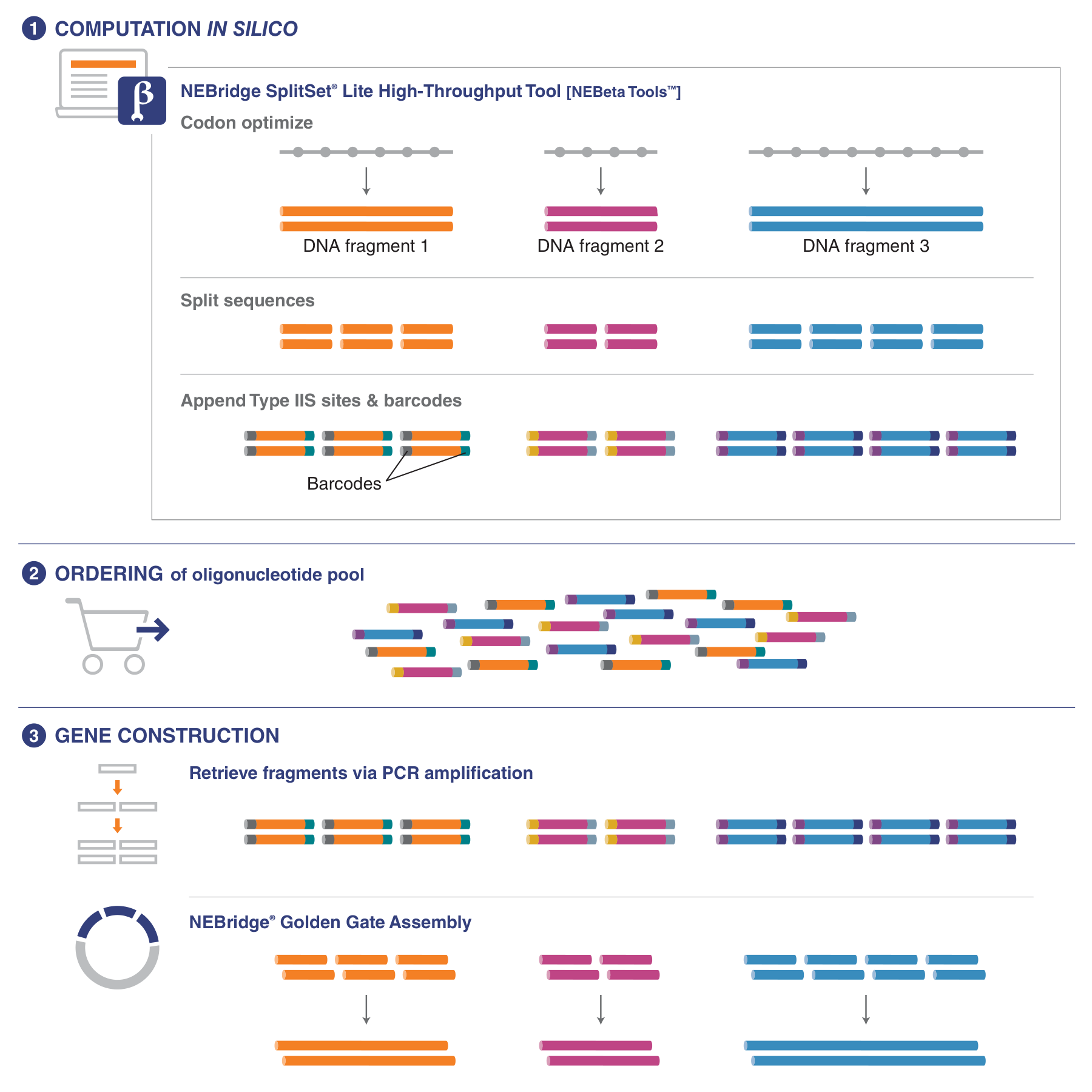
The design process was also streamlined and automated using the NEBeta™ web tool, NEBridge SplitSet Lite High-Throughput. This tool divides codon-optimized genes into equal-sized fragments at optimal break points (or fusion sites) and assigns unique barcode primers for later retrieval. It integrates directly with DAD, ensuring that fragment boundaries and overhangs are computationally optimized for both synthesis compatibility and ligation fidelity. With fragment design complete, oligonucleotides are ordered as a pool from vendors and retrieved via multiplexed PCR, allowing hundreds of gene designs to be accessed in parallel. The next step is Golden Gate Assembly, which uses Type IIS restriction enzymes and T4 DNA ligase to seamlessly assemble the DAD-optimized fragments in a single, one-pot reaction.
The Central Role of Golden Gate Assembly
While NEBridge SplitSet Lite High-Throughput and DAD are essential for the design phase, NEBridge Golden Gate Assembly (GGA) executes construction. GGA leverages Type IIS restriction enzymes (such as BsaI-HF®v2 or BsmBI-v2) to cleave the DNA at positions that are offset from their recognition sites. This allows researchers to generate custom four-base overhangs with any desired sequence at defined positions. Each DNA fragment can have unique matching ends, allowing them to fit together in only one correct order. Once assembled, the recognition sites are removed, so they cannot be cut again. This results in a single, seamless DNA construct with no extra bases between fragments.
Unlike homology-based cloning, which depends on long single-stranded overlaps that can form secondary structures or mispair, GGA enables simultaneous, directional ligation of multiple fragments in a single reaction. Paired with DAD-optimized overhangs, the efficiency and specificity of assembly increases, even for challenging constructs.
A Streamlined Three-Step Workflow that Reduces DNA Construction Timeframes from Weeks to Days
The full workflow is straightforward to implement in the lab:
- Design and retrieval of fragments from pooled oligonucleotides. This step uses NEBridge SplitSet Lite High-Throughput to divide the input sequences into codon-optimized fragments, then appends appropriate Type IIS restriction enzyme sites and assigns unique barcodes. The fragment design is guided by DAD to ensure optimized ligation fidelity. After obtaining the oligo pool, fragments are directly retrieved via a single round of multiplex PCR using a single primer pair, followed by purification.

- DAD-guided Golden Gate Assembly of each target gene. The retrieved fragments are assembled in a one-pot reaction using a Type IIS restriction enzyme and T4 DNA Ligase.
- Transformation of E. coli. Assembled constructs are screened and sequence verified.
This pipeline reduces what is often a multi-week commercial synthesis process into four days of lab work, without requiring highly specialized equipment!
Experimental Validation at Scale
To test the robustness of the method, Lund et al. attempted to construct 458 genes from two oligonucleotide pools. Their results highlight the power and scalability of this workflow:
- 343 genes were successfully assembled, yielding sequence-verified constructs.
- A total of 389 kilobases of functional DNA were constructed.
- High success rates were observed for assemblies of ≤12 fragments, with modest declines for larger constructs.
- Synthesized genes included sequences rejected by commercial providers due to extreme GC content (>70% or <30%), high repeat content or predicted structural complexity.
In short, the workflow not only succeeded where commercial services often fail, but it succeeded at scale.
The Big Wow is the Cost Reduction
While the technical elegance of the approach is compelling, the most striking outcome is economic. By using pooled oligonucleotides as the starting material, the method bypasses the high markup of pre-synthesized dsDNA fragments.
- On average, the workflow delivered a greater than three-fold reduction in raw DNA costs compared to ordering dsDNA fragments.
- When all sequences within a pool were successfully assembled, the cost savings exceeded five-fold.
For an academic lab, the difference between spending tens of thousands of dollars versus only a few can define whether an ambitious project is feasible at all. For biotech startups, the savings accelerate and broaden the range of possible design explorations.
Decentralization will Accelerate Life Science Research
The broader impact is clear: this workflow makes benchtop gene synthesis accessible to all.
- Academic labs gain the ability to construct challenging sequences at the bench, empowering researchers to explore ideas unconstrained by cost and "not synthesizable" rejections from commercial vendors.
- Early-stage companies can reduce costs and remove limitations to exploring more design possibilities, which speeds product development.
- Educational programs can introduce hands-on gene construction at scale, exposing students to advanced synthetic biology techniques.
Most importantly, decentralization redistributes control. Instead of depending on the turnaround times of external vendors, researchers can implement and design-build-test their own constructs.
Limitations and Future Directions
The study also highlighted areas for improvement:
- Assemblies with more than 12 fragments showed reduced efficiency, underscoring the need for careful construct design.
- Error rates in oligo synthesis remain a contributing factor to occasional failures.
Nevertheless, these challenges are addressable. As oligo synthesis, sequencing technologies, and computational design algorithms continue to improve, the ceiling for this approach will continue to rise.
A Shift in DNA Economics
The Lund et al. workflow represents more than a technical advance — it is a shift in the economics and accessibility of DNA synthesis. By reducing costs by three- to five-fold, accelerating turnaround to four days and enabling the assembly of sequences previously deemed "difficult," it makes decentralized, lab-scale DNA construction a practical reality.
For the synthetic biology community, this development redefines what is possible. The next generation of researchers will not be asking, "Can we afford to build this?" but rather, "How much can we explore with the resources we already have?"
In a field where the pace of discovery is constrained as much by economics as by biology, that is the true breakthrough.
Read the Full Research Paper
Visit the NEBridge SplitSet Lite High-Throughput Tool
NEB will not rent, sell, or otherwise transfer your data to a third party for monetary consideration. See our Privacy Policy for details. View our Community Guidelines.
Products and content are covered by one or more patents, trademarks and/or copyrights owned or controlled by New England Biolabs, Inc (NEB). The use of trademark symbols does not necessarily indicate that the name is trademarked in the country where it is being read; it indicates where the content was originally developed. All other trademarks are the property of their respective owners. The use of this product may require the buyer to obtain additional third-party intellectual property rights for certain applications. For more information, please email busdev@neb.com.
Don’t miss out on our latest NEBinspired blog releases!
- Sign up to receive our e-newsletter
- Download your favorite feed reader and subscribe to our RSS feed
Be a part of NEBinspired! Submit your idea to have it featured in our blog.