Cloning into the dbDNA™ Vector
Return to Closed-ended DNA & ProtelomerasesIntroduction
dbDNA (doggybone™ DNA) is a linear, closed-ended double-stranded (ds) DNA construct enabling fast, cell-free production of high-purity DNA through enzymatic methods. The EnClose® Cell-free dbDNA Synthesis Kit is optimized for enzymatic synthesis of closed-ended linear dsDNA containing your sequence of interest (SOI).
The kit provides the dbDNA Vector, which serves as the destination vector for your SOI prior to dbDNA production, and is compatible with a variety of NEB-supported cloning methods.
The dbDNA Vector (Figure 1) is the starting point for the dbDNA synthesis workflow. It is designed to serve as both a flexible destination vector for your SOI, and as an input for positive control reactions in the kit.
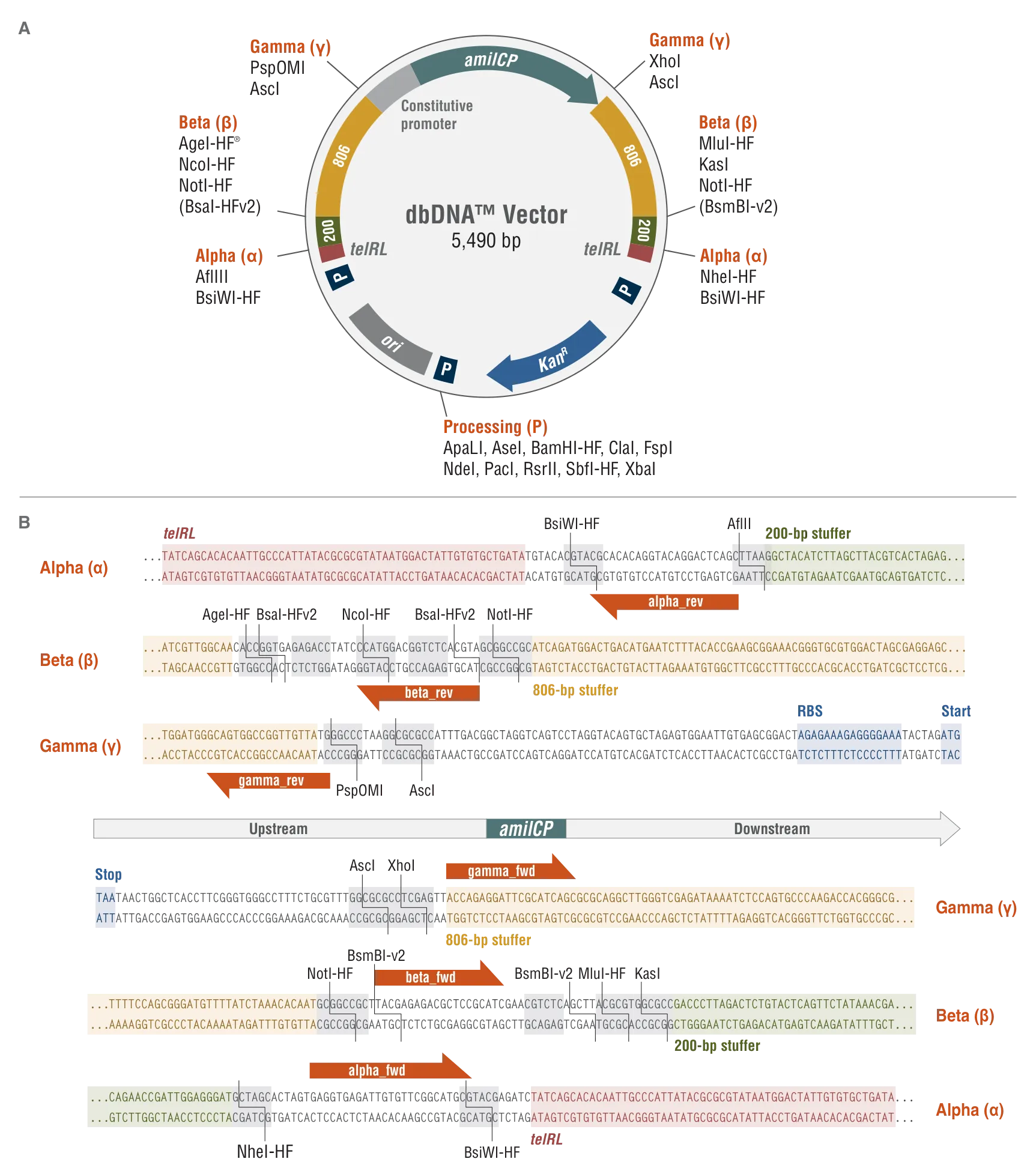
B. Upstream (top) and downstream (bottom) sequence of dbDNA Vector for traditional restriction enzyme cloning and NEBuilder® HiFi DNA Assembly primer design.
Strategies for Cloning a Sequence of Interest into the dbDNA Vector
Cloning your SOI into the dbDNA Vector can be achieved using several NEB-supported methods:
- Traditional restriction endonuclease (RE) cloning
- NEBuilder® HiFi DNA Assembly
- NEBridge® Golden Gate Assembly (ideal for inserting high-complexity repetitive elements)
Regardless of which cloning method you choose, there are three primary strategies for cloning into the dbDNA vector, termed alpha (α), beta (β), and gamma (γ) (see Table 1). The strategy employed depends on the downstream application of the dbDNA being produced (see Table 2), and they differ in the stuffer regions flanking the SOI upstream and downstream of the telRL recognition sequences (see Figure 1).
Some specific examples include:
- AAV payload dbDNA containing highly structured ITRs – it can be beneficial to have added space between the ITR elements and the telRL end of the dbDNA
- LV sequences – stuffers greatly improve functionality and provide a primer binding region to facilitate sequencing (1)
Table 1: Cloning strategy descriptions
|
Cloning Strategy |
Description |
Compatible Restriction Enzymes* |
|---|---|---|
|
Alpha (α) |
The alpha strategy employs no stuffers, and the SOI is cloned approximately 30 bp from the upstream and downstreamtelRLrecognition sequences. Exact spacing depends on the cloning method employed (i.e. RE, NEBuilder). The α strategy is suitable and recommended for standard non-viral downstream applications such as mRNA production, among others. |
|
|
Beta (β) |
The beta strategy employs flanking 200 bp stuffers and is suitable for VSV-G pseudotyped lentiviral vector (LV) and adeno-associated virus (AAV) payloads with inverted terminal repeats (ITRs). |
|
|
Gamma (γ) |
The gamma strategy employs the same flanking 200 bp stuffers from the β strategy plus additional 806 bp suffers on either side of the SOI. The γ strategy is suitable for LV payloads containing gag, pol, and rev as well as payloads containing long-terminal repeats (LTRs). |
|
* High-Fidelity (HF®︎) REs have the same specificity as native enzymes, but have been engineered for performance and significantly reduced star activity in a single buffer (rCutSmart™ Buffer).
Table 2: Recommended cloning strategies for downstream applications
|
Downstream Application |
Cloning Strategy |
||
|---|---|---|---|
|
α |
β |
γ |
|
|
AAV payload with ITRs |
X |
✓ |
X |
|
AAVrep,cap, helper |
✓ |
O |
X |
|
LV payload with LTRs** |
X |
X |
✓ |
|
LVgag,pol, andrev |
X |
X |
✓ |
|
Pseudotyped LV VSV-G |
X |
✓ |
X |
|
Standard, non-viral |
✓ |
O |
X |
|
IVT, mRNA production |
✓ |
O |
X |
✓ = recommended, O = Optional, X = Not recommended
** LV accessory plasmids may require a larger stuffer only at the 3´ end
Alternate strategies employing asymmetric stuffers may also be suitable for some downstream applications. They are not explicitly covered in this content, but the process by which an SOI is cloned into the dbDNA Vector for such applications remains the same.
For convenience, when screening transformant colonies, the dbDNA Vector contains a constitutively expressed chromoprotein (amilCP), which produces a vibrant blue color. Colonies transformed with correctly assembled dbDNA Vector containing your SOI should therefore appear white as they will eliminate expression of this reporter.
NEB provides detailed protocols to clone via two methods:
Traditional cloning with restriction endonucleases
Cloning with REs (Table 3) is a straightforward way to introduce your SOI, and may be the preferred route when working with high-complexity, previously assembled inserts. The dbDNA Vector is equipped with a variety of restriction sites for each strategy to enable this cloning modality.
Your SOI may be derived from another plasmid construct, a PCR amplification, or annealed synthetic oligos. It must contain the same upstream and downstream restriction sites for your chosen strategy (Table 3). To ensure efficient digestion by REs, an additional 6 bases insulating the restriction site from the ends of the insert are required when preparing from a PCR amplification or annealed oligos. Synthetic oligos can be phosphorylated using T4 Polynucleotide Kinase (NEB #︎M0201).
REs that leave non-compatible ends allow for unidirectional cloning of your SOI and prevent self-ligation of empty dbDNA Vector. When orientation does not affect the downstream utility of the dbDNA product, bidirectional cloning may select for a more stable clone configuration. When opting for bidirectional cloning it is important to dephosphorylate the dbDNA Vector after digestion to prevent self-ligation. Dephosphorylation can be carried out with Quick CIP (NEB #︎M0525) directly in the restriction digest reaction.
Alternate strategies employing asymmetric stuffer configurations can utilize additional RE combinations beyond those listed in Table 3. For example, to retain both the downstream 806 bp and 200 bp stuffers, but only the upstream 200 bp stuffer, AflII could be utilized with either XhoI or AscI, the latter of which is normally only used for bidirectional cloning in the γ cloning strategy.
Table 3: Restriction endonuclease information for traditional restriction cloning into dbDNA Vector
|
Cloning Strategy |
Restriction Enzyme |
Cut Site |
Notes |
|---|---|---|---|
|
Alpha (α) |
5´…C▼TTAAG…3´ 3´…GAATT▲C…5´ |
Upstream, no stuffer |
|
|
5´…G▼CTAGC…3´ 3′…CGATC▲G…5´ |
Downstream, no stuffer |
||
|
5´…C▼GTACG…3´ 3´…GCATG▲C…5´ |
Bidirectional, no stuffer |
||
|
Beta (β) |
5´…A▼CCGGT…3´ 3´…TGGCC▲A…5´ |
Upstream, 200-bp stuffer |
|
|
5´…C▼CATGG…3′ 3´…GGTAC▲C…5′ |
Upstream, 200-bp stuffer |
||
|
5´…A▼CGCGT…3´ 3´…TGCGC▲A…5´ |
Downstream, 200-bp stuffer |
||
|
5´…G▼GCGCC…3´ 3´…CCGCG▲G…5´ |
Downstream, 200-bp stuffer |
||
|
5´…GC▼GGCCGC…3´ 3´…CGCCGG▲CG…5´ |
Bidirectional, 200-bp stuffer |
||
|
Gamma (γ) |
5´…G▼GGCCC…3´ 3´…CCCGG▲G…5´ |
Upstream, 200-bp stuffer and 806-bp stuffer |
|
|
5´…C▼TCGAG…3´ 3´…GAGCT▲C…5´ |
Downstream, 200-bp stuffer and 806-bp stuffer |
||
|
5´…GG▼CGCGCC…3´ 3´…CCGCGC▲GG…5´ |
Bidirectional, 200-bp stuffer and 806-bp stuffer |
Protocol: Cloning into dbDNA™ Vector using Restriction Enzymes
This is a general cloning workflow employing the Beta (β) strategy using high-fidelity restriction enzymes (REs) AgeI-HF® and MluI-HF® to insert sequences of interest (SOI) into dbDNA Vector provided with the EnClose™ Cell-free dbDNA™ Synthesis Kit (NEB #E9301).
This strategy is suitable for cloning previously assembled inserts of high complexity (e.g. sequences containing ITRs) into the vector to obtain dbDNA for downstream applications such as AAV payloads with ITRs and pseudotyped LV vector.
Seamless cloning with NEBuilder HiFi DNA Assembly Mix
Cloning with NEBuilder®︎ HiFi DNA Assembly is fast, efficient, and offers a superior seamless cloning experience in comparison to traditional cloning methods. NEBuilder HiFi DNA Assembly is the recommended cloning method for most dbDNA applications, and enables virtually error-free, seamless joining of up to 12 fragments. It is suitable for any of the cloning strategies (α, β or γ) available in the dbDNA Vector, and offers a more modular approach for medium to high-throughput cloning of multiple SOIs.
The design of your NEBuilder®︎ assembly depends on:
- The number of fragments – e.g. swapping variable regions like UTRs in a dbDNA intended for downstream IVT.
- The number of assemblies – e.g. multiple different inserts in α, β, or γ cloning strategies.
With regard to this kit, most downstream applications can be realized using the dbDNA Vector in a 2-3 fragment assembly. This dictates the vector to insert ratio (1:2, with 5-fold excess for any fragment under 200 bp in size) and optimal overlap region size (15-20 bp).
Modularity depends largely on where the overlap regions reside: (1) overlap resides in the SOI only, (2) overlap resides in the dbDNA Vector only, or (3) overlap is shared between both. The first option provides the greatest modularity as the same fragments can be reused for multiple different SOIs. More detail regarding PCR amplification of dbDNA Vector fragments is given in the protocol linked below.
A very low input of dbDNA Vector is recommended when using PCR amplification to generate fragment(s) to minimize the risk of parental dbDNA Vector contamination in the transformation following assembly. Even a very small amount of dbDNA Vector relative to the amplification product will transform more efficiently due to its supercoiled structure. DpnI treatment of the PCR reaction helps to further reduce the risk of parental contamination. In addition to these safeguards, the amilCP reporter present in the dbDNA Vector is useful for distinguishing correctly assembled clones from those harnessing parental dbDNA Vector as these colonies will turn blue due to the constitutive promoter upstream of the amilCP reporter.
Protocol: Cloning into dbDNA™ Vector using NEBuilder®︎ HiFi DNA Assembly
This is a general workflow for cloning sequences of interest (SOI) into dbDNA™ Vector using NEBuilder®︎ HiFi DNA Assembly (NEB #E2621) with overlap regions residing only within the SOI. The resulting construct can be used downstream as rolling circle amplification (RCA) input material in the EnClose™ Cell-free dbDNA™ Synthesis Kit.
Processing restriction endonucleases for cloning into the dbDNA Vector
The dbDNA Vector contains a variety of restriction sites for downstream processing to give users flexibility in cloning without the requirement for specific domestication of their sequences. When selecting a RE for downstream processing (i.e. removal of dbDNA Vector backbone after dbDNA formation), it is important that the recognition sequence not be present in the dbDNA SOI. XbaI (also available GMP-grade) is provided in the EnClose Cell-free dbDNA Synthesis Kit as the processing RE. Ensure that the XbaI recognition sequence is not present in your SOI before using the included RE. If domestication of the SOI is not possible, the dbDNA Vector contains a variety of alternative restriction sites for downstream processing (see Table 4).
Table 4: Restriction endonuclease information for downstream processing (removal) of dbDNA Vector backbone
| RESTRICTION ENZYME | CUTSITE |
NUMBER OF SITES
|
|---|---|---|
| ApaLI | 5´…G▼TGCAC…3´ 3´…CACGT▲G…5´ |
4 |
| AseI | 5´…AT▼TAAT…3 3´…TAAT▲TA…5´ |
4 |
| BamHI-HF® | 5´…G▼GATCC…3 3´…CCTAG▲G…5´ |
4 |
| ClaI | 5´…AT▼CGAT…3 3´…TAGC▲TA…5´ |
3 |
| FspI | 5´…TGC▼GCA…3 3´…ACG▲CGT…5´ |
4 |
| NdeI | 5´…CA▼TATG…3 3´…GTAT▲AC…5´ |
3 |
| PacI | 5´…TTAAT▼TAA…3 3´…AAT▲TAATT…5´ |
3 |
| RsrII | 5´…CG▼GWCCG…3 3´…GCCWG▲GC…5´ |
4 |
| SbfI-HF | 5´…CCTGCA▼GG…3 3´…GG▲ACGTCC…5´ |
3 |
| XbaI* | 5´…T▼CTAGA…3 3´…AGATC▲T…5´ |
3 |
* Supplied with EnClose® Cell-free dbDNA™ Synthesis Kit.
References
1. Barreira, M., et al. (2023). Gene Therapy, 30(1–2), 122–131. https://doi.org/10.1038/s41434-022-00343-4