Borrowing a Phage Tactic to Identify the Target of tRNA Nucleases
To fight off phages, bacteria use defense systems that cut their own tRNAs. This stops the bacteria from making proteins and effectively shuts the cell down before the phage can take over.
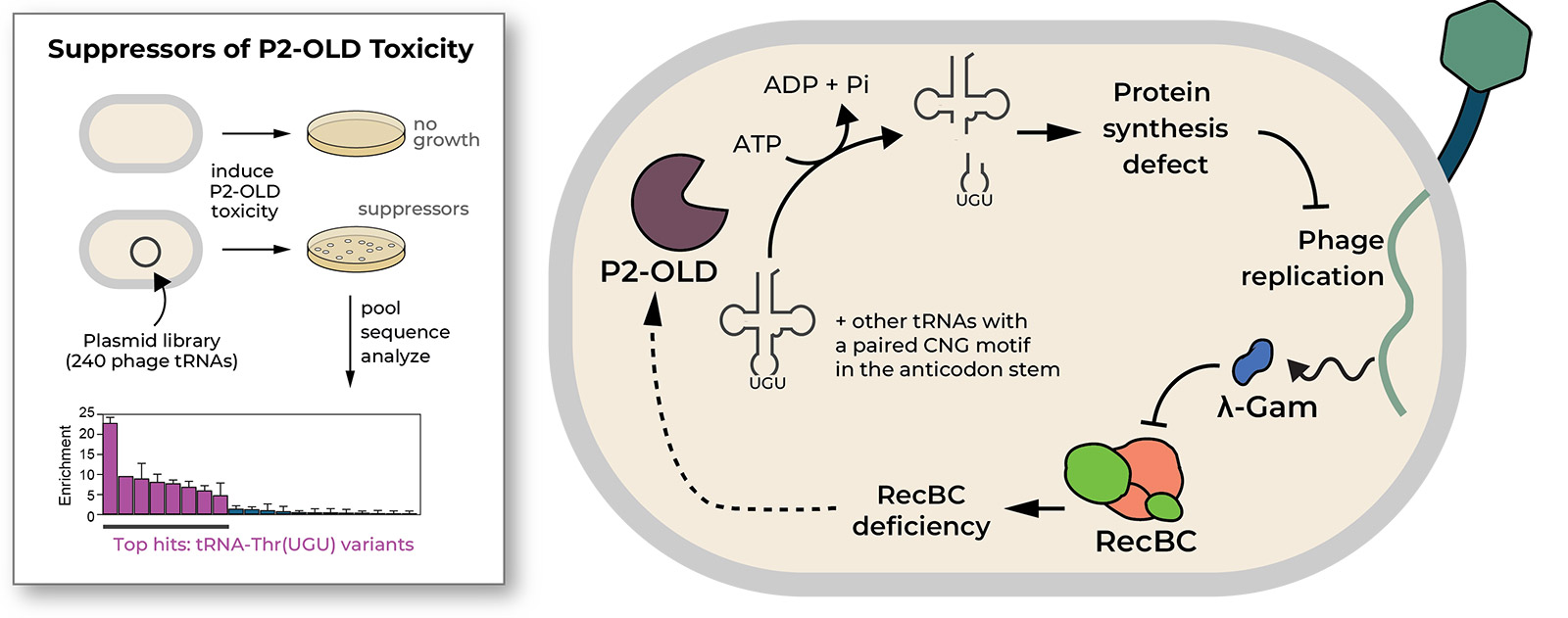
However, figuring out exactly which tRNA is being cut is often a difficult and expensive process. To solve this, we developed a new screening method inspired by phages themselves. Some phages have evolved their own special tRNAs that are resistant to being cut. These can replace the damaged ones and keep the protein-making process going.
We created a library of these special phage tRNAs and introduced them into cells with the nuclease. We then looked for the ones that were able to "rescue" the cells from being shut down. By sequencing these successful tRNAs, we could figure out which host tRNAs were being targeted. This gives us a much more efficient way to identify the targets of these tRNA-cutting nucleases.
Using our new method, we've finally solved a decades-old mystery. The Overcoming Lysogenization Defects (OLD) protein from phage P2 was discovered in 1969, but its function was unclear until now. Our research shows that P2-OLD inactivates specific host tRNAs by making two precise cuts, finally clarifying its role in this cellular battle. This work also uncovers a new molecular scissor that cut tRNAs in a way never seen before.