
RNase III Protocol Modification Can Enable Safe dsRNA Removal from IVT Samples
Posted on Monday, July 20, 2026
By
Topic: Tips for the lab
RNA therapeutics are rising in popularity for diverse medical applications, from vaccines to personalized cancer treatment. Crucially, these therapeutics require high-quality and impurity-free RNA to avoid triggering unwanted immune responses.
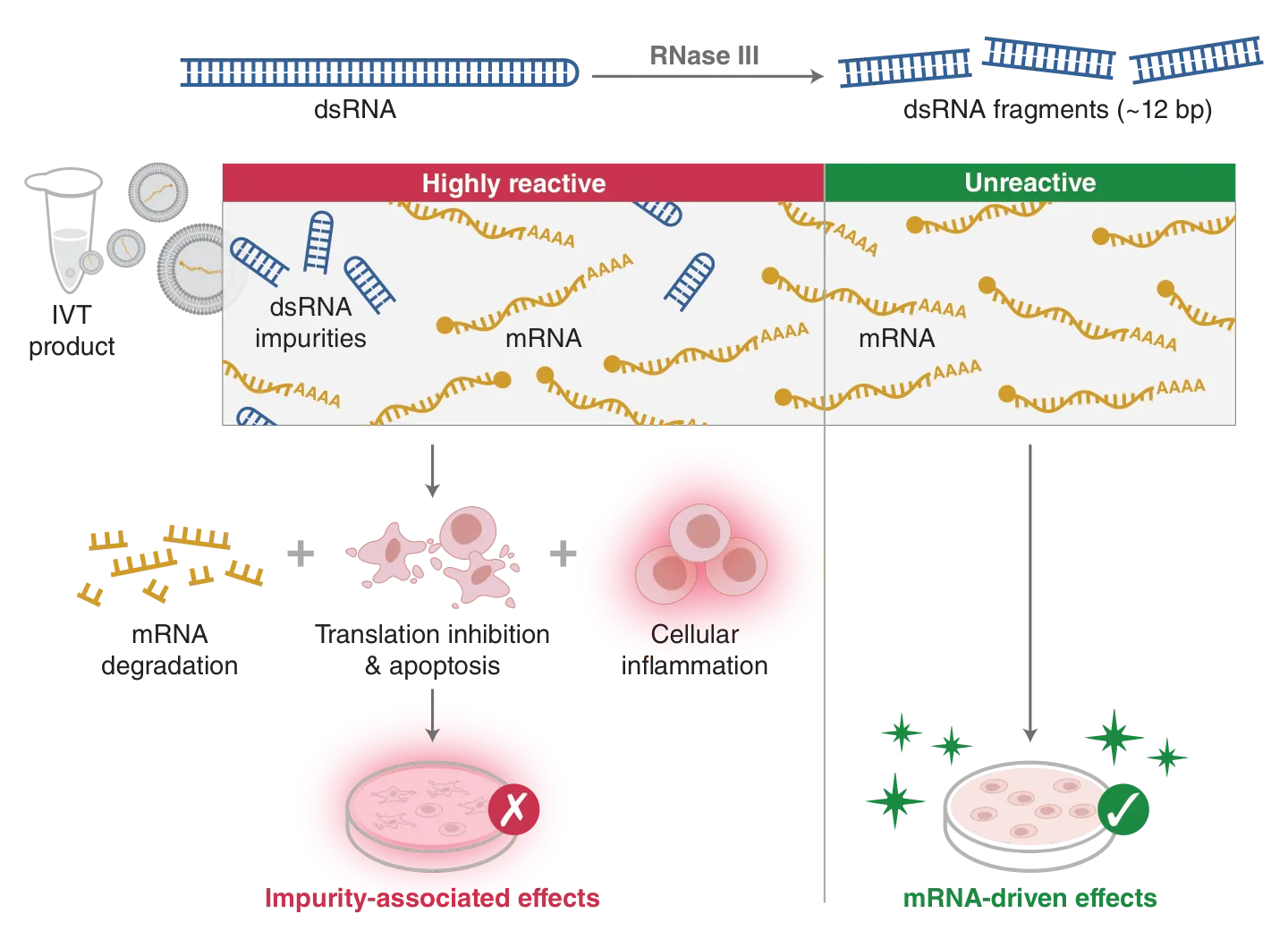
In vitro transcription can be optimized to minimize byproduct generation, but additional steps are required if double-stranded RNA (dsRNA) content is too high. In an application note released in June, New England Biolabs scientists found that slight modifications to the standard protocol for ShortCut® RNase III can remove dsRNA impurities while minimizing single-stranded RNA (ssRNA) degradation.
Using a protocol to assess the suitability of RNase III treatment, researchers can determine the best conditions to enzymatically remove dsRNA from IVT mRNA.
RNase III treatment using MgCl2 reduces dsRNA content while preserving ssRNA integrity
NEB researchers performed RNase III treatment on IVT reactions from four different substrates (CLuc, FLuc, eGFP, EPO). J2-based dot blots showed that RNase III treatment significantly reduced dsRNA presence, with the cleanest output observed when MgCl2 was the source of the divalent cation cofactor.
Additionally, they found that FLuc, eGFP, and EPO samples retained approximately 95% or higher ssRNA integrity once RNase III treatment was optimized using MgCl2.
Highly structured substrates may result in higher ssRNA degradation
CLuc was the most structured substrate studied in this application note, which showed persistent susceptibility to ssRNA degradation under the conditions needed for significant dsRNA reduction. This ssRNA degradation occurred regardless of the metal ion present in the reaction. This indicates that other dsRNA removal methods should be used for this substrate
Titrating parameters for RNase III treatment optimizes safety and efficacy
Our scientists recommend titrating the concentrations of MgCl2 and ShortCut RNase III to ensure your IVT samples stay intact and have reduced dsRNA content. Running treated samples on a gel can visually confirm sample integrity, while a J2 dot blot can be used to quantify dsRNA removal.
To learn more about RNase III-mediated dsRNA removal, including recommended starting concentrations, data assessments, and a full suggested protocol for dsRNA removal in IVT samples, read the full application note, "Use of ShortCut® RNase III for dsRNA removal from IVT samples."
Read the Full Application Note
Don’t miss out on our latest NEBinspired blog releases!
- Sign up to receive our e-newsletter
- Download your favorite feed reader and subscribe to our RSS feed
Be a part of NEBinspired! Submit your idea to have it featured in our blog.