Recombinase Polymerase Amplification and SIBA
Looking for RPA reagents, including glycerol-free T4 UvsX and UvsY? Connect with our Customized Solutions Team to explore tailored options.
Recombinase polymerase amplification (RPA) and strand-invasion based amplification (SIBA) are isothermal amplification methods enabled through the activity of a recombinase enzyme which help primers invade into double-stranded DNA. T4 UvsX Recombinase is used in combination with its accessory protein, UvsY, and the single-stranded binding protein gp32 to form D-loop recombination structures for initiation of amplification by Bsu or another mesophilic strand-displacing DNA polymerase. RPA uses two oligonucleotides as forward and reverse primers like an “isothermal PCR” while SIBA also includes a longer invasion oligo to help facilitate the strand invasion and amplification. Uniquely, among the isothermal methods, RPA can produce amplicons up to 1 kb (primer-to-primer distance). Both RPA and SIBA are typically done at ~37 °C, avoiding the higher temperatures of other methods, though nonspecific amplification can be a common challenge. Probes can be used with either method to detect specific products. In addition to diagnostic amplification applications, recombinase-based amplification has shown utility for clonal amplification in next generation sequencing workflows.
| Reaction Temperature | Amplicon Size | Detection Method(s) |
|---|---|---|
| 37°C | <1,000 nt | Fluorescence, Lateral flow |
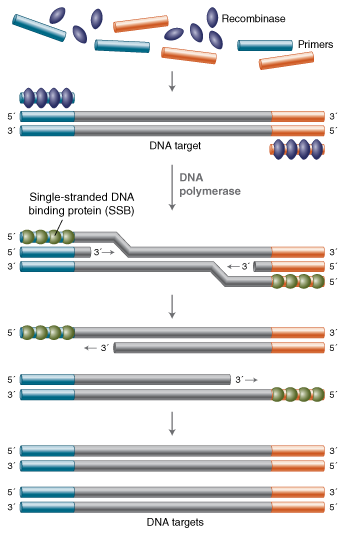
RPA utilizes a recombinase-primer complex, a strand-displacing polymerase, and single-stranded DNA binding proteins to facilitate amplification of discrete DNA products up to 1 kb (primer-to-primer distance).