Exploring the Hidden Diversity of Unorthodox Genomes
Posted on Saturday, October 24, 2026
By
Topic: What is Trending in Science
The molecular biology of nucleic acids is typically discussed using conventional categories such as chromosomes, plasmids, viruses, and mobile genetic elements. However, the biological diversity around us does not always fit neatly into those classifications. Some genetic entities are smaller than expected, others are larger and more complex, and some depend on viruses or host systems in ways that blur familiar boundaries.
These difficult-to-define entities were the focus of New England Biolabs’ recent research symposium, Unorthodox Genomes. The free, one-day event was held in Boston, was open to the broader scientific community, and brought together invited speakers from across the globe to examine genetic systems that sit outside traditional categories.
The speakers discussed the unique characteristics of these molecular entities, which share several key features: they exist outside a host’s chromosomes, rely on host cellular machinery for replication, and can move genetic information between cells. Collectively, they reshape microbial populations and reveal new mechanisms of gene flow. As our understanding of these unorthodox replicating systems evolves, so too does our biological definition of life.
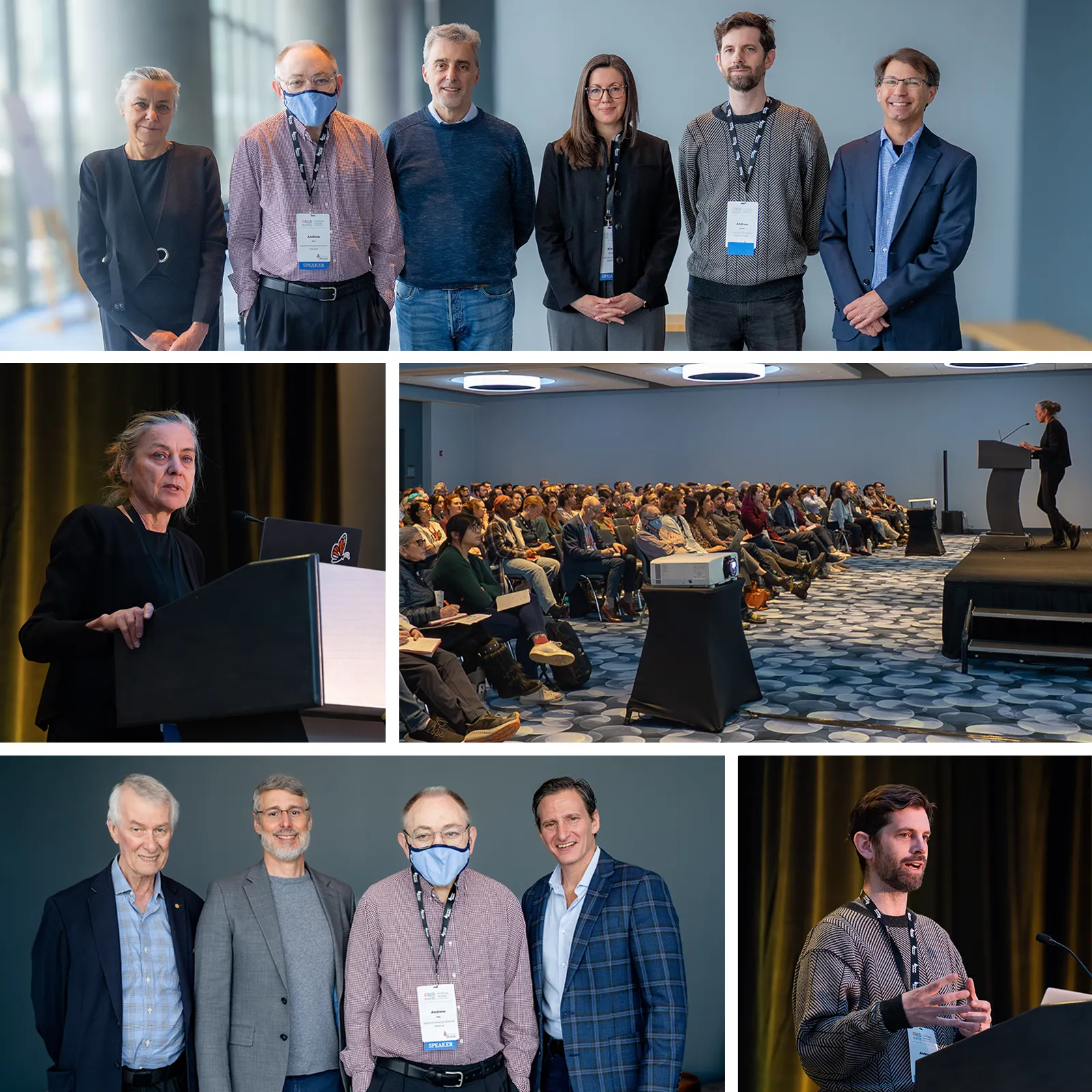
Clockwise from top: (L to R) Jill Banfield, Andy Fire, José Penadés, Kim Seed, Andrew Varble & Joe Pogliano; Jill Banfield; Andrew Varble; (L to R) Rich Roberts (NEB Chief Scientific Officer), Tom Evans (NEB Executive Director of Research), Andy Fire & Sal Russello (NEB CEO); Jill Banfield
Highlights from the Symposium
Throughout the symposium, speakers described genetic entities that vary dramatically in size, structure, and biology. Together, their talks showed how research into unorthodox genomes is revealing new molecular processes, expanding familiar categories, and raising fundamental questions about how genetic systems persist, spread, and shape microbial life.
Obelisks: Small genetic entities hiding in plain sight
The scientific program opened with Dr. Andy Fire (Stanford University) describing computational strategies his lab has taken to uncover overlooked biological features in sequencing databases. His group identified small, apparently circular RNAs (~1000 bases) with predicted rod-like secondary structures that are prevalent in gut and oral metatranscriptomes (Zheludev et al., 2024). The team named these molecules “obelisks,” inspired by the structural resemblance to ancient obelisk monuments. RNA obelisks differ from viruses because they lack a protein shell and are more akin to viroids, small naked circular RNAs that cause disease in plants. Unlike viroids, however, obelisks are detected within bacterial cells and have distinct sequences and secondary structures. The lab is now extending this search to ask whether overlooked forms of life might exist outside the familiar archaeal, bacterial, and eukaryotic domains.
However, there is still much to learn about obelisks themselves. How do they spread? Do they impact human health? Are obelisks descendants of the pre-cellular RNA world? After reading the seminal paper from the Fire Lab, Dr. Andrew Varble (University of Rochester) was eager to answer some of these questions. He shared ongoing work to develop experimental systems to dissect the fundamental molecular mechanisms by which small extrachromosomal elements propagate. Their efforts aim to illuminate how these enigmatic RNAs maintain themselves and what they might reveal about the boundaries of biological organization.
Watch Andrew Varble's Presentation
Phage Satellites: Genetic hitchhikers and parasites of parasites
The symposium next turned to phage satellites: mobile genetic elements that depend on helper bacteriophages for replication and spread. Typically, 5–20 kb in size, phage satellites are smaller than the bacteriophages they exploit. In the most simplistic terms, they can be thought of as parasites of parasites.
Dr. José Penadés (Imperial College London) has long studied these mobile genetic elements. In his talk, he explored how deeply phage satellites are intertwined with their viral hosts. In a recent twist, his group found that some phage satellites encode their own capsids but borrow tails from helper bacteriophages, expanding the range of cellular hosts they can reach. His presentation underscored a recurring lesson in biology: some of the most interesting phenomena emerge in places where one was not initially searching.
Watch Jose Penade's Presentation
Watch Kim Seed's Presentation
Jumbo Phages: Giant viral genomes and the expanding scale of genome biology
While the symposium began with some of the smallest extrachromosomal genetic entities, it concluded with some of the largest and most complex phage genomes that have been discovered. Although scientists have known for decades about jumbo phages (200–500 kb) and megaphages (500 kb+), recent technological advances have made it possible to uncover their prevalence, diversity, and biological sophistication.
As Dr. Joe Pogliano (UC San Diego) emphasized, “the reason that most prior [research]…focused on smaller phage was that [they] were easier to isolate, …and unknowingly excluded jumbophage.” He presented detailed mechanistic work showing how certain bacteriophages build nucleus-like compartments inside bacterial cells to shield viral DNA from the host’s endonuclease-based defenses during replication. Through cryo-electron microscopy and image reconstruction, he and his collaborators showed that the phage pseudonucleus is spatially dynamic, rotating like a spinning ball, and selective about which proteins pass through its surrounding shell. One striking visualization showed viral capsid precursors accumulating like a bouquet of flowers around the exterior of the phage pseudonucleus as they were being filled with DNA.
In contrast to approaches that visualize large viruses directly, Dr. Jill Banfield’s group (UC Berkeley) uses metagenome sequencing to comb through total nucleic acid sequences. Over the course of her career, Dr. Banfield has pioneered methods to reconstruct microbial genomes from complex natural communities. Her work has uncovered countless unculturable viruses, bacteria, eukarya, and archaea, contributing to a redrawing of the “Tree of Life”. In her more recent work, Dr. Banfield has identified naked, intact giant extracellular genetic elements up to a million base pairs in length, which her group has coined “Borgs” (Al-Shayeb et al., 2022). Based on gene composition, Borgs appear to provide methane-oxidizing archaea with genes that support redox reactions and energy conservation. The origins of these genes can be traced to diverse microbes, suggesting that Borgs accumulate metabolic pathways as they move through microbial communities. The name is a nod to the Star Trek alien collective imagined to assimilate diverse life forms and technologies for its own benefit.
Watch Joe Pogliano's Presentation
Watch Jill Banfield's Presentation
NEB Research Symposiums
The day concluded with a poster session showcasing work of students, postdocs, and researchers from NEB and the greater research community. Together with the talks, they underscored how much remains to be discovered in the natural world.
Scientists in the NEB Research Department organize the NEB Research Symposium. Fifty years after its founding, NEB continues to invest in basic science and to create meaningful opportunities for researchers to connect, exchange ideas, and collaborate. By providing an open forum for scientific dialogue, the symposium reflects NEB’s longstanding commitment to advancing fundamental research. Previous NEB symposia have explored environmental DNA (eDNA) and structural biology.
We are excited to announce that the next NEB Research Symposium, “The Integrated Multiome,” will be hosted on March 25, 2027, in Boston, MA. Registration will be available soon! We hope to see you there and welcome ideas for future symposium topics that NEB should help bring to the forefront of scientific conversation.
Don’t miss out on our latest NEBinspired blog releases!
- Sign up to receive our e-newsletter
- Download your favorite feed reader and subscribe to our RSS feed
Be a part of NEBinspired! Submit your idea to have it featured in our blog.